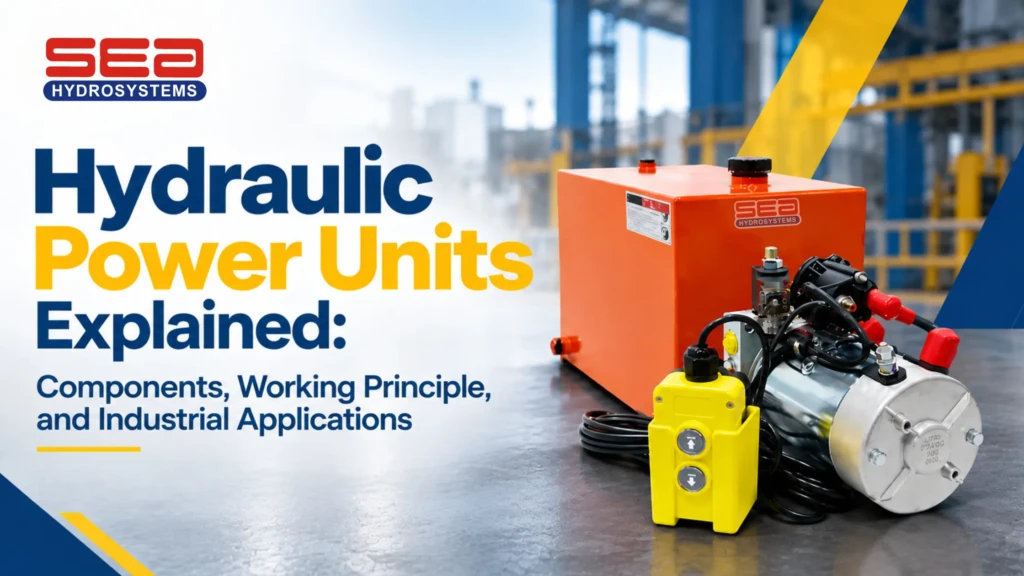
A hydraulic power unit is a self-contained source of hydraulic power that supplies fluid flow and pressure to cylinders, motors, and other hydraulic actuators. Understanding how these systems work helps engineers and equipment operators select the right configuration for their application and maintain reliable performance.
At SEA Hydrosystems, we design and manufacture hydraulic solutions for industrial, mobile, and marine equipment applications.
What Is a Hydraulic Power Unit?
A hydraulic power pack is a self-contained assembly that typically includes a motor, pump, reservoir, valves, filtration, and other hydraulic control components.
The unit supplies hydraulic fluid to the connected circuit, where control valves direct the flow to cylinders, motors, or other actuators. The configuration can vary depending on the required pressure, flow rate, duty cycle, and application.
A hydraulic power unit can be used when equipment requires a dedicated hydraulic power source rather than a centralized plant hydraulic system.
Main Components of a Hydraulic Power Unit
Electric or Engine-Driven Motor
The motor provides the mechanical power needed to drive the hydraulic pump.
Depending on the application, the power source may be an electric motor, internal-combustion engine, or another suitable prime mover.
Hydraulic Pump
The pump converts mechanical input into hydraulic fluid flow. System resistance and load determine the pressure developed within the circuit.
Common pump types include:
- Gear pumps
- Vane pumps
- Piston pumps
Pump selection depends on required flow, pressure, efficiency, duty cycle, and application requirements.
Reservoir
The reservoir stores hydraulic fluid and provides space for heat dissipation, air separation, and settling of some contaminants.
Reservoir size and configuration should be selected according to the hydraulic circuit, fluid volume, operating temperature, and installation requirements.
Valves and Manifolds
Directional, pressure-control, flow-control, check, and other valves regulate how hydraulic fluid moves through the system.
A hydraulic power pack may use an integrated manifold to combine multiple valves into a compact assembly and simplify hydraulic connections.
Filters
Filters help control contamination in hydraulic fluid and protect pumps, valves, cylinders, and motors from premature wear.
Filter location and specification should be selected according to the circuit design and cleanliness requirements.
For additional technical information about hydraulic filtration and filter selection, see this hydraulic filtration resource.
How a Hydraulic Power Unit Works
The motor drives the pump, which draws hydraulic fluid from the reservoir and delivers flow into the hydraulic circuit.
As the fluid encounters resistance from the actuator and other components, pressure develops in the system. Control valves regulate the direction and flow of fluid to the connected cylinder or motor.
After performing work, the hydraulic fluid returns through the circuit to the reservoir, where it can be filtered, cooled, and recirculated.
The complete operation of a hydraulic power unit depends on the interaction between the pump, valves, reservoir, filtration system, hydraulic fluid, and connected actuators.
Common Industrial Applications
A hydraulic power pack can be used in many applications where controlled hydraulic force or motion is required.
Common applications include:
- Industrial presses
- Material handling equipment
- Lifting platforms
- Mobile and truck-mounted equipment
- Marine deck machinery
- Automated manufacturing equipment
- Specialized OEM machinery
In an industrial hydraulic system, the power unit can supply hydraulic flow to one or more actuators according to the machine’s control requirements.
Types of Hydraulic Power Units
Standard Power Units
Standard units are available in common pressure, flow, motor, and reservoir configurations.
They can be suitable for applications where the required hydraulic operating conditions match an existing configuration.
Custom Power Units
Custom-configured units are engineered around specific flow, pressure, reservoir capacity, motor power, valve configuration, mounting, and control requirements.
A custom hydraulic power unit can be particularly useful for OEM equipment and specialized machinery with unique installation or performance requirements.
Compact and Mobile Power Units
Compact units are designed for applications with limited installation space or mobile equipment requirements.
These systems can integrate the motor, pump, reservoir, valves, and other components into a smaller package.
Selecting the Right Hydraulic Power Unit
Choosing the correct hydraulic power unit requires an understanding of the complete hydraulic circuit and the connected equipment.
Key factors to evaluate include:
- Required flow rate
- Operating and maximum pressure
- Motor power requirements
- Duty cycle and operating time
- Reservoir capacity
- Available installation space
- Mounting orientation
- Ambient temperature
- Hydraulic fluid requirements
- Noise and environmental requirements
The pump, motor, reservoir, valves, and filtration system should be selected as a complete system rather than as separate components.
Hydraulic Power Unit Efficiency and Performance
The performance of a hydraulic power pack depends on proper component selection, system design, fluid condition, and operating conditions.
Important considerations include:
- Matching pump flow to actual system requirements
- Selecting an appropriate motor size
- Minimizing unnecessary pressure losses
- Maintaining proper hydraulic fluid cleanliness
- Providing suitable cooling when required
- Using appropriate control valves
Proper sizing can help reduce unnecessary energy consumption and support reliable operation.
Maintaining a Hydraulic Power Unit
Regular maintenance helps protect the components of an industrial hydraulic system and reduce unexpected downtime.
Maintenance checks should include:
- Check hydraulic fluid level and condition regularly
- Inspect hoses, fittings, and connections for leaks
- Replace filters according to the application and manufacturer’s recommendations
- Monitor unusual pump noise or vibration
- Check reservoir breathers and filler openings for contamination
- Inspect valves and manifolds for leakage
- Monitor operating temperature
- Check pressure and flow when performance changes occur
Fluid cleanliness is particularly important because contamination can accelerate wear in pumps, valves, and other hydraulic components.
For additional information about hydraulic system design and fluid conditioning, see this hydraulic power system reference.
Custom Hydraulic Power Unit Solutions
Standard configurations may not always meet the requirements of specialized machinery.
Custom hydraulic power pack configurations can be developed around:
- Required pressure and flow
- Motor and pump selection
- Reservoir capacity
- Valve and manifold configuration
- Mounting dimensions
- Electrical controls
- Cooling requirements
- Environmental conditions
A custom configuration allows the power unit to be integrated more effectively into the equipment’s available space and hydraulic circuit.
Why Choose SEA Hydrosystems?
SEA Hydrosystems provides hydraulic solutions for industrial, mobile, and marine equipment applications.
Our engineering team works with customers to understand requirements such as flow, pressure, duty cycle, installation space, and connected actuator requirements.
For applications requiring cylinders and other hydraulic components, we also provide custom hydraulic cylinder solutions designed around specific equipment requirements.
Need a Hydraulic Power Unit for Your Application?
If your equipment requires a reliable hydraulic power source, SEA Hydrosystems can help evaluate your application requirements and develop a suitable solution.
Our team can support hydraulic system requirements involving flow, pressure, power, controls, installation space, and connected hydraulic actuators.
Contact our team to discuss your requirements