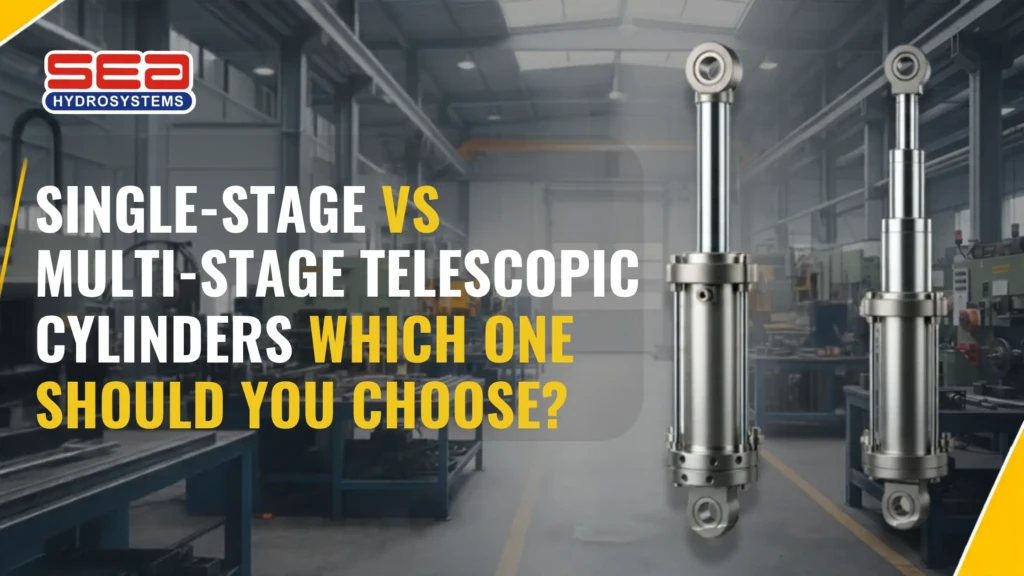
Selecting the right hydraulic cylinder is an important engineering decision for equipment manufacturers. The cylinder must provide the required lifting force, stroke length, and operating performance while fitting within the available installation space. These requirements become particularly important in dump trucks, tipping trailers, agricultural machinery, and other equipment that requires substantial lifting movement.
A telescopic cylinder is designed to provide an extended stroke from a relatively compact retracted length. Depending on the application, equipment manufacturers can choose between a conventional single-stage arrangement and a design with multiple nested stages.
Each configuration has different characteristics relating to installation dimensions, load capacity, pressure requirements, maintenance, and overall project cost. Understanding these differences helps OEMs make better decisions during equipment design and hydraulic system planning.
At SEA Hydrosystems, we understand the importance of selecting suitable hydraulic solutions for demanding equipment applications. This guide explains the design differences, selection factors, practical applications, and maintenance considerations buyers should evaluate before choosing a cylinder configuration.
Understanding How Telescopic Cylinders Work
A telescopic design uses nested cylindrical sections that extend progressively to achieve a longer overall stroke. The sections are arranged concentrically, allowing the cylinder to remain relatively compact when fully retracted.
Depending on the design, the cylinder may operate using a single-acting or double-acting hydraulic arrangement.
In a single-acting design, hydraulic pressure extends the stages, while gravity or an external mechanical force may assist retraction. In a double-acting arrangement, hydraulic pressure is used to control both extension and retraction.
The actual operating sequence depends on the internal hydraulic passages, stage arrangement, and cylinder design.
The main components generally include:
- Outer barrel: The main structural section that houses the internal stages.
- Intermediate stages: Nested sections that extend sequentially to provide additional stroke.
- Piston or stage sealing arrangements: Components that help maintain pressure separation between sections.
- Wear rings and guide components: Support alignment and help control contact between moving surfaces.
- Ports and hydraulic connections: Allow fluid to enter and leave the cylinder.
- Mounting components: Connect the cylinder to the equipment structure.
The number of stages, their diameters, and their stroke contributions determine the overall dimensions and performance characteristics.
What Is a Single-Stage Hydraulic Cylinder?
A single-stage design uses one main moving piston and rod arrangement to produce the required stroke. It has a comparatively straightforward construction and fewer moving interfaces than a nested multi-stage arrangement.
A single-stage hydraulic cylinder is generally considered where the equipment can accommodate the required cylinder length and where a simpler construction is preferred.
The available stroke is closely related to the cylinder’s overall dimensions. Therefore, achieving a long stroke may require considerable installation space.
Its main characteristics include:
- Relatively simple internal construction.
- Fewer moving stages and sealing interfaces.
- Straightforward inspection and servicing.
- Suitable for applications where installation length is available.
- Design flexibility for different mounting and load requirements.
This configuration can be a practical option for industrial machinery and lifting equipment where the required stroke can be accommodated without creating packaging difficulties.
However, when the equipment has limited frame clearance, achieving the necessary stroke with a conventional design may require changes to the equipment layout.
What Is a Multi-Stage Telescopic Cylinder?
A multi-stage telescopic cylinder contains two or more nested moving sections. These sections extend in sequence, allowing the assembly to achieve a long stroke while maintaining a shorter retracted length.
The largest stage generally begins the extension process, followed by smaller stages according to the cylinder’s internal design and hydraulic arrangement.
This configuration is particularly useful in equipment where a long lifting movement is required but the available installation space is restricted.
Key characteristics include:
- Long stroke from a relatively compact retracted package.
- Multiple nested sections that extend progressively.
- More complex sealing and guiding arrangements.
- Additional design considerations relating to pressure and load at different stages.
- Greater attention required during assembly, inspection, and maintenance.
The final performance depends on the diameter, wall thickness, stage arrangement, manufacturing materials, mounting design, and operating conditions.
Key Differences Between Single-Stage and Multi-Stage Designs
Although both configurations perform hydraulic lifting functions, their construction and application suitability differ.
| Comparison factor | Single-stage design | Multi-stage design |
| Construction | One main moving stage | Two or more nested stages |
| Stroke length | Limited by overall cylinder geometry | Long stroke from a compact package |
| Retracted length | Generally longer for equivalent stroke | Generally shorter for equivalent stroke |
| Installation space | Requires more longitudinal space | Suitable for restricted installation space |
| Sealing arrangement | Fewer moving interfaces | More sealing and guiding interfaces |
| Maintenance | Generally simpler | Requires attention to multiple stages |
| Design complexity | Comparatively straightforward | More complex |
| Typical applications | Industrial machinery and suitable lifting systems | Dump trucks, tipping trailers, and compact lifting equipment |
A single-stage hydraulic cylinder may be a suitable choice when the required stroke and installation dimensions can be achieved without using multiple nested sections.
The comparison is general. Actual performance depends on the specific cylinder design, operating pressure, load conditions, mounting arrangement, and application requirements.
Stroke Length and Retracted Length: Why They Matter
Stroke length and retracted length are two of the most important dimensions in cylinder selection.
Stroke length refers to the distance through which the cylinder extends. Retracted length is the overall length when the cylinder is fully collapsed.
For equipment manufacturers, both measurements must be considered together.
For example, a dump trailer may require a substantial lifting movement to achieve its intended tipping angle. However, the available space beneath the trailer body may be limited.
A conventional cylinder with sufficient stroke could be too long to fit into the available frame area. A nested design may provide the required movement within a shorter installation package.
Before selecting a configuration, engineers should evaluate:
- Required cylinder stroke.
- Available retracted installation length.
- Mounting point locations.
- Clearance throughout the complete movement.
- Maximum extended length.
- Interference with the chassis, body, hoses, and nearby components.
The selected design should meet the required movement without creating installation or structural problems.
Load Capacity and Pressure Considerations
Load capacity is another important factor when comparing different cylinder configurations.
The theoretical force generated by a hydraulic cylinder depends on its effective pressure area and the hydraulic pressure applied.
For a conventional piston arrangement:
Force = Pressure × Effective piston area
For example, a cylinder operating at a specified pressure generates force based on its effective piston area. However, the actual lifting capacity of equipment also depends on mounting geometry, mechanical leverage, friction, load distribution, and operating conditions.
In nested configurations, the effective area can change as different stages operate. This means engineers must calculate the available force at the relevant extension positions rather than relying only on the largest stage’s dimensions.
Important considerations include:
- Maximum operating pressure.
- Effective area of each stage.
- Required lifting force throughout the stroke.
- Load position and centre of gravity.
- Mechanical advantage of the equipment structure.
- Pressure losses and hydraulic system limitations.
- Structural strength and stability at full extension.
A design should be evaluated against its required operating conditions, including the most demanding expected lifting position.
Understanding Pressure Derating in Nested Designs
Pressure derating is an important consideration when designing cylinders with different stage diameters.
As smaller stages extend, their effective pressure areas may differ from those of the larger stages. Consequently, the available force at a given pressure can change throughout the extension sequence.
For a basic illustration, consider two hypothetical stages:
- Stage A has an effective area of 100 cm².
- Stage B has an effective area of 60 cm².
At the same hydraulic pressure, the theoretical force generated by Stage B is lower because its effective area is smaller.
This is a simplified illustration, not a rating for a particular cylinder. Actual force calculations must account for the hydraulic architecture, effective areas, pressure limitations, mechanical geometry, and design specifications.
Engineers should verify the rated load and pressure requirements for every relevant stage and extension position.
For additional engineering guidance on pressure-rating verification and fatigue assessment, refer to the telescopic cylinder pressure rating and fatigue testing requirements published under NFPA/T3.6.31.
How Stage Count Influences Design and Maintenance
The number of stages affects the overall dimensions, internal arrangement, manufacturing complexity, and maintenance requirements.
A two-stage design may offer a useful compromise between stroke length and installation space. Three-stage or four-stage configurations may be appropriate when equipment requires greater extension from a particularly compact retracted package.
However, adding stages can introduce:
- Additional sealing arrangements.
- More guiding and wear components.
- More dimensional interfaces to control.
- Additional assembly and inspection requirements.
- Greater complexity during repair and rebuilding.
The highest possible stage count is not necessarily the best solution. Engineers should select the minimum practical number of stages that meets the stroke, space, load, and performance requirements.
Real-World Applications: Dump Trucks and Tipping Trailers
Different equipment designs demonstrate why cylinder selection should be based on application requirements.
Standard Dump Trucks
Dump trucks commonly require hydraulic lifting systems to raise the body and discharge material.
The selection depends on the body dimensions, chassis arrangement, required tipping angle, payload, and available mounting space.
Where sufficient installation length is available, a simpler cylinder arrangement may be practical. Where a long stroke is required within a restricted frame area, a nested configuration may provide a better fit.
Narrow-Bed and Low-Profile Trailers
Low-profile trailers often have limited space beneath the trailer body. The cylinder must fit within this space while still providing the movement required to reach the intended tipping position.
In these situations, a compact retracted design can be particularly useful.
Agricultural Machinery
Agricultural equipment may use hydraulic cylinders for lifting, positioning, tipping, and other movement functions.
The selection should consider the operating environment, dust and moisture exposure, available installation space, duty cycle, and expected loads.
Material-Handling Equipment
Material-handling machinery may require extended movement from a limited installation area. The cylinder configuration should be evaluated against the equipment’s movement path, load distribution, stability, and operating frequency.
Engineering Factors Before Selecting a Configuration
Cylinder selection should begin with a clear understanding of the equipment’s operating requirements.
Equipment manufacturers can also consult international fluid power engineering standards when reviewing hydraulic cylinder construction, safety, testing, and inspection requirements.
1. Required Stroke
Determine the total movement required for the application. This should be based on the actual equipment geometry and operating position rather than an approximate measurement.
2. Available Installation Space
Measure the available space in both the retracted and fully extended positions. Include mounting points and surrounding equipment components.
3. Operating Pressure
Confirm the hydraulic system’s working pressure and any relevant pressure limitations. The selected cylinder must be designed for the intended operating conditions.
4. Load and Lifting Geometry
Calculate the load that must be moved and consider how the cylinder mounting position affects the force required throughout the movement.
5. Duty Cycle
Determine how frequently the cylinder will operate. Occasional lifting and continuous industrial cycling may require different design and maintenance considerations.
6. Environmental Conditions
Consider temperature, moisture, dust, corrosion exposure, and other environmental factors that may affect materials, coatings, seals, and service life.
7. Maintenance Requirements
Evaluate seal availability, inspection access, replacement procedures, and the availability of suitable repair services.
For applications where installation space is sufficient, a single-stage hydraulic cylinder may provide a practical balance of construction simplicity, servicing, and operating requirements.
Material Selection and Surface Protection
Material selection affects structural strength, weight, wear resistance, and resistance to environmental conditions.
The barrel, moving stages, piston rods, and mounting components should be manufactured from materials suitable for the specified operating conditions.
Surface protection is particularly important where exposed sections experience repeated movement and contact with the surrounding environment.
Important considerations include:
- Appropriate material grades for the specified pressure and load.
- Suitable surface finishing for sliding and sealing areas.
- Corrosion protection based on environmental exposure.
- Compatible seal materials for the selected hydraulic fluid.
- Wear resistance for guiding and contact surfaces.
- Material documentation where required by the customer.
Coating thickness, surface finish, and material selection should be defined according to the engineering requirements rather than assumed to be identical across all applications.
Installation Best Practices
Even a correctly designed cylinder can experience operational problems if it is installed incorrectly.
Equipment manufacturers and installation teams should verify the following:
- Mounting brackets are suitable for the expected load and movement.
- Cylinder alignment is maintained throughout the full stroke.
- Mounting pins and joints are compatible with the design.
- Hydraulic hoses have sufficient movement allowance.
- Connections are properly secured and free from contamination.
- The cylinder does not experience unintended side loading.
- Clearance is maintained between the cylinder and nearby components.
The installation should be checked through the complete movement range before the equipment enters normal operation.
Maintenance and Troubleshooting Considerations
Maintenance requirements depend on the cylinder design, operating environment, load, and usage frequency.
Regular inspection can help identify early signs of wear or damage before they lead to more serious operational problems.
Hydraulic Leakage
External leakage may be associated with damaged seals, connection problems, surface damage, or incorrect installation.
Uneven Extension
Uneven movement may result from hydraulic system issues, contamination, mechanical interference, misalignment, or problems within the cylinder.
Rod or Stage Surface Damage
Scratches, corrosion, and coating damage can affect sealing and wear performance. Exposed surfaces should be inspected regularly.
Excessive Wear
Wear in guide components or sealing areas may be associated with contamination, side loading, alignment issues, or operating conditions outside the design requirements.
Slow or Incomplete Retraction
Possible causes include hydraulic circuit problems, mechanical restrictions, seal issues, or an unsuitable retraction arrangement.
Maintenance teams should follow the manufacturer’s service instructions and use appropriate procedures for inspection, disassembly, and repair.
Evaluating Total Lifecycle Cost
The initial purchase price does not represent the complete cost of a hydraulic cylinder.
A lifecycle evaluation should consider:
- Initial cylinder purchase cost.
- Equipment design and installation costs.
- Maintenance and replacement expenses.
- Repair and rebuild requirements.
- Equipment downtime.
- Spare-parts availability.
- Expected operating conditions.
- Long-term equipment productivity.
A compact configuration may have a higher initial component cost but avoid expensive equipment redesign or structural modifications.
Conversely, a simpler configuration may offer better overall value where adequate installation space is available and maintenance simplicity is a priority.
The correct decision should consider the total equipment cost and operating requirements rather than component price alone.
Repair and Rebuild Considerations
Repair requirements can differ depending on the internal construction and number of moving stages.
A single-stage hydraulic cylinder may be comparatively straightforward to disassemble, inspect, and rebuild. Nested designs can require more specialised knowledge because of their multiple stage interfaces, sealing arrangements, and dimensional requirements.
Before selecting a configuration for a fleet or production platform, OEMs should consider:
- Availability of replacement seals and wear components.
- Access to qualified repair services.
- Availability of technical drawings and service documentation.
- Inspection requirements for individual stages.
- Expected maintenance intervals.
- Spare-parts planning for long-term operation.
Planning for repair and component availability during the initial design stage can help reduce future maintenance difficulties.
Single-Stage vs Multi-Stage: Which Design Is Better for Your Application?
There is no universal answer because each configuration solves a different engineering problem.
A simpler arrangement may be appropriate when the available installation space is sufficient and the application prioritises straightforward construction and servicing.
A nested arrangement may be more suitable when the equipment requires a long stroke from a compact retracted length.
The final decision should be based on the following priorities:
| Application requirement | Design consideration |
| Adequate installation length | Consider a simpler cylinder arrangement |
| Long stroke with limited space | Consider nested stages |
| Frequent servicing | Evaluate seal and component accessibility |
| High lifting loads | Calculate force at all relevant extension positions |
| Restricted equipment geometry | Evaluate mounting and clearance carefully |
| High-duty operation | Review cycle requirements and thermal conditions |
For OEMs, involving a hydraulic cylinder engineering partner early in the equipment design process can help avoid unnecessary redesign and improve the integration of the hydraulic system.
Frequently Asked Questions
What is the main difference between single-stage and multi-stage cylinders?
A single-stage cylinder uses one main moving piston and rod arrangement, while a multi-stage design uses multiple nested sections to provide a longer stroke from a shorter retracted package.
When should equipment manufacturers choose a multi-stage design?
It is generally worth considering when a long stroke is required but the available installation space is restricted. The load, pressure, mounting geometry, and maintenance requirements must also be evaluated.
Does increasing the number of stages reduce lifting capacity?
Not automatically in every design. However, the effective pressure area and force can differ between stages. Engineers should calculate the available force at each relevant extension position.
Are nested cylinders more difficult to maintain?
They can require more detailed inspection and specialised repair procedures because they contain additional sealing and guiding interfaces. Maintenance requirements depend on the design and operating conditions.
What information is required to select the correct cylinder?
Important information includes required stroke, retracted length, operating pressure, load, mounting dimensions, duty cycle, environmental conditions, and the intended application.
Can the same cylinder configuration be used for different equipment?
A design may be suitable for multiple applications if the technical requirements are compatible. However, load conditions, installation geometry, and operating requirements should be verified for each equipment design.
Why is mounting alignment important?
Incorrect alignment can introduce side loading and increase wear on rods, guides, seals, and other components. The mounting arrangement should maintain suitable alignment throughout the cylinder’s movement.
Why Choose SEA Hydrosystems for Your Hydraulic Requirements?
Selecting the right cylinder configuration requires an understanding of equipment geometry, stroke requirements, operating pressure, load conditions, and long-term maintenance needs.
SEA Hydrosystems works with customers to understand their application requirements and identify suitable hydraulic solutions for industrial and mobile equipment.
Whether your project requires a compact lifting arrangement or a specialised cylinder design, discussing the technical requirements early can help establish the appropriate configuration.
Explore our custom hydraulic cylinder solutions or contact our team to discuss your equipment requirements.
Contact: sales@seahydrosys.com
Choose the right cylinder configuration to support equipment performance, reliable operation, and long-term value.