


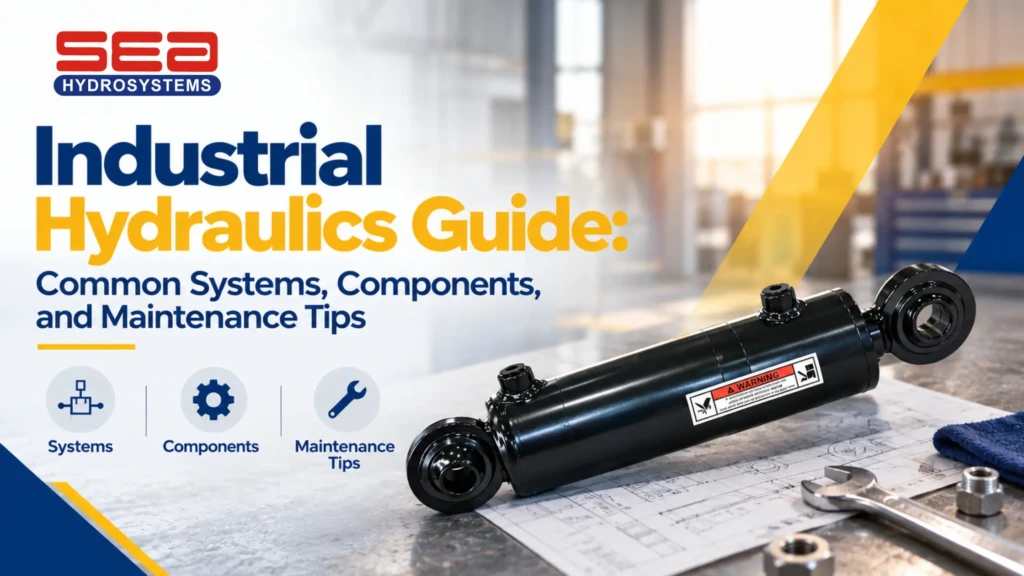
Understanding industrial hydraulics is important for engineers, equipment operators, and maintenance teams responsible for hydraulic machinery. Hydraulic systems use pressurized fluid to transmit power and control movement in equipment used for manufacturing, material handling, construction, processing, and other demanding applications.
At SEA Hydrosystems, we manufacture hydraulic cylinders and components used in a wide range of industrial hydraulic systems.
What Are Industrial Hydraulics?
Industrial hydraulics refers to the use of pressurized hydraulic fluid to transmit power and produce controlled mechanical movement.
Hydraulic pumps generate fluid flow, while valves control the direction, pressure, and flow of the fluid. Hydraulic cylinders convert hydraulic energy into linear motion, while hydraulic motors provide rotary motion.
These components work together as an industrial hydraulic system to perform functions such as lifting, pressing, clamping, positioning, and material handling.
Common Types of Industrial Hydraulic Systems
Open-Circuit Systems
In an open-circuit system, the pump draws hydraulic fluid from a reservoir and sends it through the hydraulic circuit to the required actuator. Fluid then returns to the reservoir after performing its function.
This configuration is widely used in many hydraulic applications because it provides a practical method of circulating and conditioning hydraulic fluid.
Closed-Circuit Systems
In a closed-circuit system, hydraulic fluid circulates primarily between the pump and actuator, while additional circuits may provide charge fluid, cooling, filtration, and makeup flow.
Closed-circuit arrangements are commonly used where precise control of hydraulic power and speed is required.
Hydrostatic Drive Systems
Hydrostatic drive systems use hydraulic power to transmit rotary motion and control speed and direction.
They are commonly used in mobile and specialized equipment where variable-speed hydraulic transmission is required.
The appropriate configuration for an industrial hydraulic system depends on the required pressure, flow, actuator type, control method, duty cycle, and application.
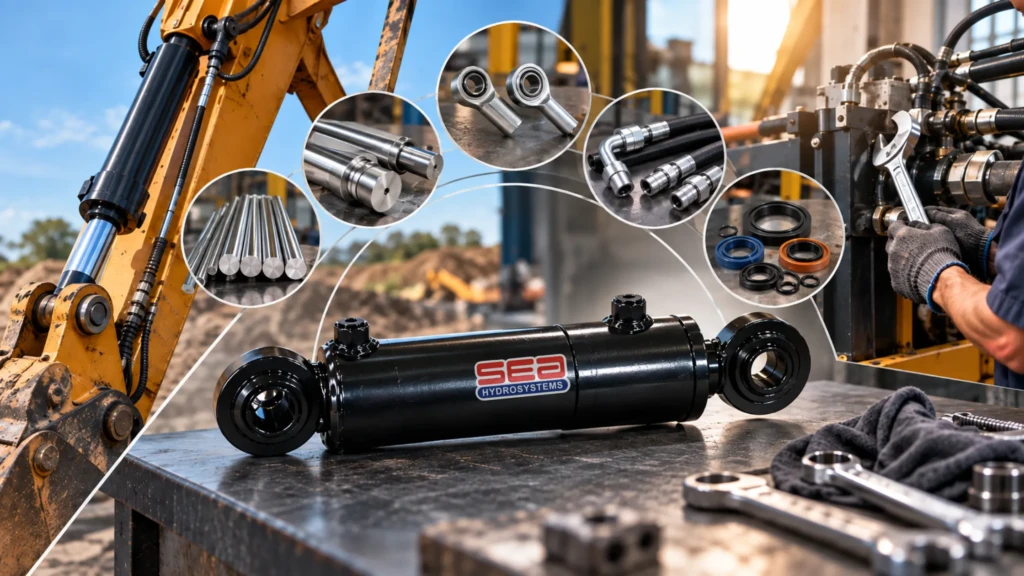
Key Components in Industrial Hydraulic Systems
An industrial hydraulic system typically includes several components that work together to generate, control, and use hydraulic power.
Important components include:
- Hydraulic pumps for generating fluid flow
- Hydraulic cylinders for linear force and movement
- Hydraulic motors for rotary motion
- Directional control valves for controlling actuator movement
- Pressure-control valves for regulating system pressure
- Flow-control valves for controlling actuator speed
- Reservoirs for storing hydraulic fluid
- Filters for controlling fluid contamination
- Hoses, tubes, fittings, and manifolds for fluid distribution
- Coolers or heat exchangers where temperature control is required
The correct combination of components depends on the machine’s pressure, flow requirements, load, duty cycle, operating temperature, and environmental conditions.
How Industrial Hydraulic Systems Work
A typical industrial hydraulic system begins with a pump drawing fluid from the reservoir and delivering flow into the hydraulic circuit.
Control valves direct the fluid toward the required actuator. A hydraulic cylinder converts hydraulic energy into linear movement, while a hydraulic motor converts hydraulic energy into rotary movement.
After passing through the actuator and other components, the fluid returns through the circuit to the reservoir, where it can be filtered and conditioned before being recirculated.
Proper component sizing and system configuration are important for achieving reliable hydraulic performance.
Common Causes of Industrial Hydraulic System Failure
Hydraulic failures can result from contamination, improper operation, component wear, poor maintenance, or incorrect system design.
Common causes include:
- Dirt and particulate contamination
- Water or other fluid contamination
- Excessive operating temperature
- Incorrect hydraulic fluid viscosity
- Pump cavitation caused by restricted inlet flow or other conditions
- Worn seals and damaged hydraulic cylinders
- Excessive side loading or misalignment
- Incorrect pressure or flow settings
- Damaged hoses, fittings, or connections
Contamination is particularly important because particles and other contaminants can accelerate component wear and reduce system reliability.
Appropriate filtration and fluid cleanliness are therefore important parts of hydraulic system maintenance.
For additional information about hydraulic filtration and contamination control, see this hydraulic filtration resource.
Hydraulic System Maintenance Tips
Regular hydraulic system maintenance helps identify developing problems before they result in unexpected downtime.
Recommended practices include:
- Monitor hydraulic fluid level and condition
- Maintain appropriate fluid cleanliness
- Replace or service filters according to system requirements
- Inspect hoses and fittings for leaks, cracks, and abrasion
- Check hydraulic cylinders for rod damage and seal leakage
- Inspect mounting points and connections
- Monitor system pressure and operating temperature
- Keep reservoirs, breathers, and filler openings clean
- Maintain accurate service and inspection records
- Investigate unusual noise, vibration, or changes in machine performance
Consistent hydraulic system maintenance can help reduce unexpected failures and support longer service life for hydraulic components.
Hydraulic Fluid and Contamination Control
Hydraulic fluid performs several important functions, including transmitting energy, lubricating moving components, transferring heat, and helping maintain appropriate internal clearances.
Contamination from dirt, water, air, worn components, or improper fluid handling can contribute to premature component wear and reduced system performance.
Good hydraulic system maintenance should therefore include:
- Using the correct hydraulic fluid
- Keeping fluid containers and filling equipment clean
- Maintaining appropriate filtration
- Preventing contaminants from entering open hydraulic connections
- Monitoring fluid condition when required
- Addressing the source of contamination rather than only replacing filters
For additional information about contamination control in hydraulic systems, see this hydraulic contamination control resource.
Building Reliable Industrial Hydraulic Systems
Reliable industrial hydraulics starts with selecting components that match the machine’s actual operating requirements.
Consider:
- Required pressure and flow
- Cylinder or motor force requirements
- Operating speed
- Duty cycle
- Hydraulic fluid
- Temperature range
- Installation space
- Environmental exposure
- Filtration requirements
- Maintenance accessibility
Components should be selected as part of the complete system rather than independently.
Proper sizing, installation, fluid cleanliness, and hydraulic system maintenance all contribute to reliable equipment operation.
When Custom Hydraulic Components Are Required
Standard components may not always meet the dimensional, pressure, stroke, mounting, or environmental requirements of specialized equipment.
Custom hydraulic cylinders can be designed around application-specific requirements such as:
- Bore and rod dimensions
- Stroke length
- Mounting configuration
- Operating pressure
- Seal system
- Port location
- Environmental conditions
- Duty cycle
Explore our custom hydraulic cylinder solutions for specialized industrial applications.
Design Considerations for Industrial Hydraulic Systems
When designing industrial hydraulic systems, engineers should consider how each component will operate together under actual working conditions.
Important considerations include:
- Required force and actuator speed
- Pump flow and pressure requirements
- Valve configuration and control requirements
- Reservoir capacity
- Filtration and contamination control
- Heat generation and cooling requirements
- Hose and piping arrangement
- Accessibility for inspection and maintenance
- Operating environment and temperature
A complete system approach can help improve reliability and make future hydraulic system maintenance easier.
Why Choose SEA Hydrosystems?
SEA Hydrosystems manufactures hydraulic cylinders and components for demanding equipment applications.
Our engineering team works with customers to understand requirements such as load, stroke, operating pressure, mounting configuration, duty cycle, and environmental conditions.
From standard components to custom solutions, we support customers looking for reliable industrial hydraulics for specialized machinery and equipment.
Need Components for Your Industrial Hydraulic System?
If you are looking for reliable components for an industrial hydraulic system, SEA Hydrosystems can help evaluate your application requirements.
Our team can support hydraulic cylinder and component requirements based on your equipment’s pressure, load, stroke, operating conditions, and performance requirements.
Contact our team to discuss your requirements

