


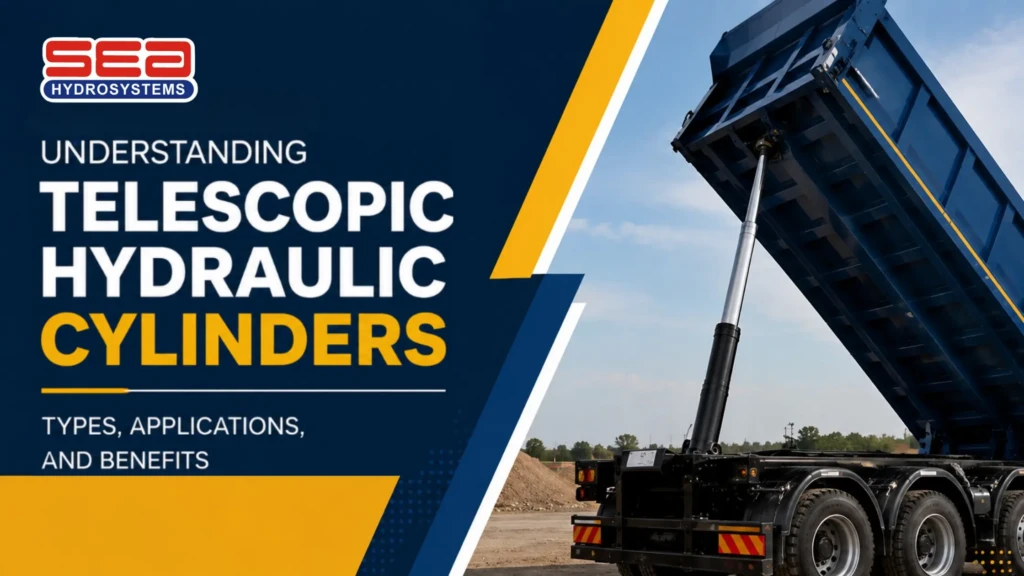
When equipment requires a long stroke but has limited space for cylinder installation, a telescopic cylinder can provide an effective solution. Unlike a conventional single-stage cylinder, a telescopic hydraulic cylinder uses multiple nested stages to achieve a long extension from a relatively compact retracted length.
At SEA Hydrosystems, we design and manufacture hydraulic cylinders for demanding industrial and mobile equipment applications, including equipment requiring long-stroke and space-efficient cylinder configurations.
How a Telescopic Hydraulic Cylinder Works
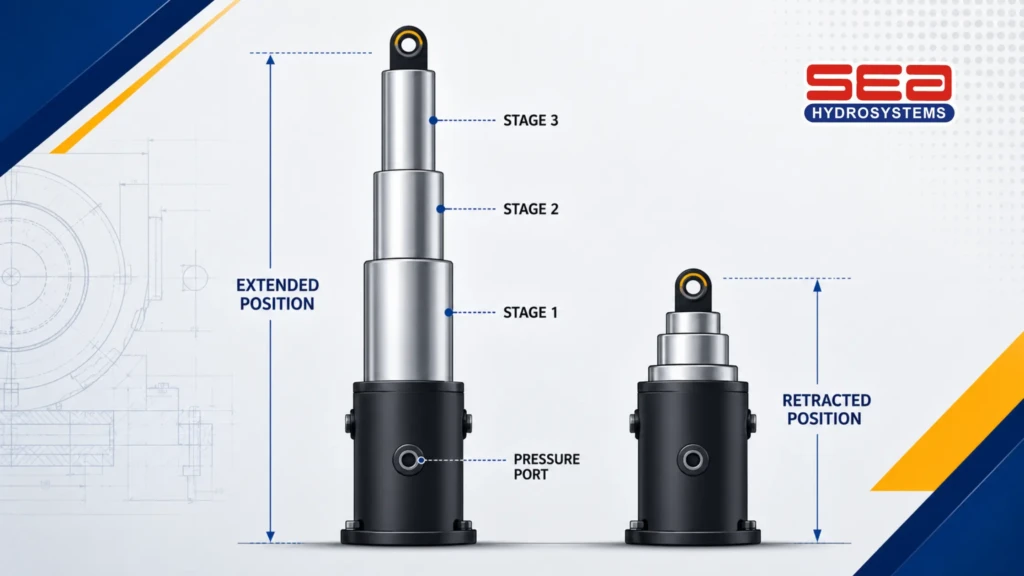
A telescopic cylinder consists of multiple tubular stages nested inside one another. Hydraulic pressure causes the stages to extend according to the cylinder’s internal design and sequencing arrangement.
As the stages extend, the cylinder provides a long overall stroke while maintaining a shorter retracted length than a conventional cylinder with the same travel.
A multi-stage hydraulic cylinder can be designed with different numbers of stages depending on the required stroke, retracted length, load, and installation space.
Types of Telescopic Hydraulic Cylinders
Single-Acting Telescopic Cylinders
Single-acting telescopic cylinders extend using hydraulic pressure and retract through gravity or an external load. They are commonly used in dump bodies, tipping trailers, and similar applications.
Double-Acting Telescopic Cylinders
Double-acting telescopic cylinders use hydraulic pressure for both extension and retraction. They provide greater control when the cylinder must actively retract rather than relying on gravity or the machine load.
Multi-Stage Telescopic Cylinders
A multi-stage hydraulic cylinder contains several nested stages to achieve a longer stroke within a limited retracted length.
The number of stages can be selected according to the required stroke, available installation space, load requirements, and cylinder configuration.
Common Applications for Telescopic Cylinders
Telescopic cylinders are commonly used in applications where long extension and compact retracted dimensions are important.
Common applications include:
- Dump trucks and dump trailers
● Refuse and recycling equipment
● Agricultural trailers
● Material handling equipment
● Marine deck equipment
● Specialty lifting and tipping equipment
Single-acting telescopic tipping cylinders are also covered by ISO 5670, which specifies interchangeability dimensions and test pressure for certain agricultural trailer applications. (iso.org)
Benefits of Telescopic Hydraulic Cylinders
Telescopic hydraulic cylinders offer several advantages for equipment with demanding stroke and space requirements.
Benefits include:
- Long stroke length in a compact retracted package
● Reduced installation space requirements
● Multiple stage configurations for different stroke requirements
● High force capability for lifting and tipping applications
● Flexible design options for specialized equipment
The main advantage is the ability to achieve substantial extension without requiring the same retracted length as a conventional single-stage cylinder.
Factors That Affect Telescopic Cylinder Performance
Several design factors influence the performance and reliability of a telescopic cylinder.
Number of Stages
Increasing the number of stages can provide a longer stroke within a shorter retracted length. However, additional stages also introduce more components, seals, and interfaces that must be properly designed and maintained.
The number of stages should be selected based on the required stroke, available installation space, load, pressure, and duty cycle.
Stage Diameter and Wall Thickness
Stage diameter and wall thickness affect cylinder strength, weight, stability, and resistance to mechanical loads.
The design should provide adequate strength for the expected hydraulic pressure and external loading conditions.
Force at Different Stages
The effective piston area changes as different stages operate. As a result, the available force can vary between stages depending on the cylinder design and hydraulic pressure.
Engineers should consider the required load at each stage rather than evaluating only the cylinder’s maximum rated force.
Seal Design
Each telescopic stage may require its own sealing and guiding arrangement. Proper seal selection is important for controlling leakage, preventing contamination, and maintaining reliable stage movement.
Seal materials should be compatible with the hydraulic fluid, operating temperature, pressure, speed, and environmental conditions.
Mounting and Side Loading
Correct cylinder alignment and mounting are important for telescopic cylinders because excessive side loading can increase wear on stages, seals, and guiding components.
The mounting arrangement should be designed to keep the cylinder properly aligned with the equipment throughout its operating range.
Choosing the Right Telescopic Cylinder
Selecting the correct telescopic cylinder depends on the required stroke, load capacity, retracted length, mounting arrangement, operating pressure, and duty cycle.
Key questions to consider when specifying a telescopic cylinder include:
- What is the maximum retracted length available for installation?
● What lifting height or total stroke is required?
● What load must the cylinder move or support?
● How many stages are required to achieve the desired stroke?
● What operating pressure will the hydraulic system provide?
● Will the cylinder operate in a corrosive, dusty, or high-debris environment?
● What mounting and alignment requirements must be considered?
Providing complete application information helps the manufacturer select an appropriate cylinder configuration.
Maintenance Considerations for Telescopic Cylinders
Because telescopic cylinders contain multiple stages and sealing components, regular inspection is important for reliable operation.
Maintenance checks should include:
- Inspect each exposed stage for scratches, scoring, pitting, or corrosion
● Check for hydraulic oil leakage around stage seals
● Keep exposed cylinder surfaces clean and free from debris
● Inspect mounting points and connections for looseness or damage
● Monitor uneven, slow, or delayed stage movement
● Check for unusual noise or vibration during operation
● Inspect seals and replace damaged components when necessary
Early identification of stage or seal problems can help prevent more extensive cylinder damage and unexpected equipment downtime.
Testing and Quality Control for Telescopic Cylinders
Telescopic cylinders should undergo appropriate inspection and testing based on their design, operating conditions, and application requirements.
Testing may include:
- Dimensional inspection
● Pressure or proof testing
● Leakage inspection
● Functional testing
● Mounting and alignment checks
● Cycle testing where required
ISO 10100:2020 specifies acceptance and function tests for hydraulic fluid power cylinders and can be used as a reference when establishing appropriate cylinder testing requirements. (iso.org)
The specific testing program should be determined according to the cylinder design and customer requirements.
Custom Telescopic Hydraulic Cylinder Solutions
Standard telescopic cylinders may not always meet the dimensional, load, stroke, or mounting requirements of specialized equipment.
Custom designs can be developed around factors such as:
- Bore and stage diameters
● Number of stages
● Overall retracted length
● Total stroke
● Mounting configuration
● Seal system
● Port arrangement
● Operating pressure
● Environmental conditions
Explore our custom hydraulic cylinder solutions for applications requiring specialized cylinder configurations.
Why Choose SEA Hydrosystems for Telescopic Cylinders?
SEA Hydrosystems designs and manufactures hydraulic cylinders for industrial and mobile equipment applications.
Our engineering team can work with customers to understand requirements such as stroke, load, installation space, mounting configuration, operating conditions, and duty cycle.
For applications requiring long stroke lengths in limited installation spaces, a telescopic hydraulic cylinder can provide a practical and space-efficient solution.
Need a Telescopic Hydraulic Cylinder?
If your equipment requires a long-stroke cylinder with a compact retracted length, SEA Hydrosystems can help evaluate your application requirements.
Our team can support you with cylinder selection, custom design, and manufacturing for demanding lifting, tipping, and specialized equipment applications.
Contact our team to discuss your requirements

