


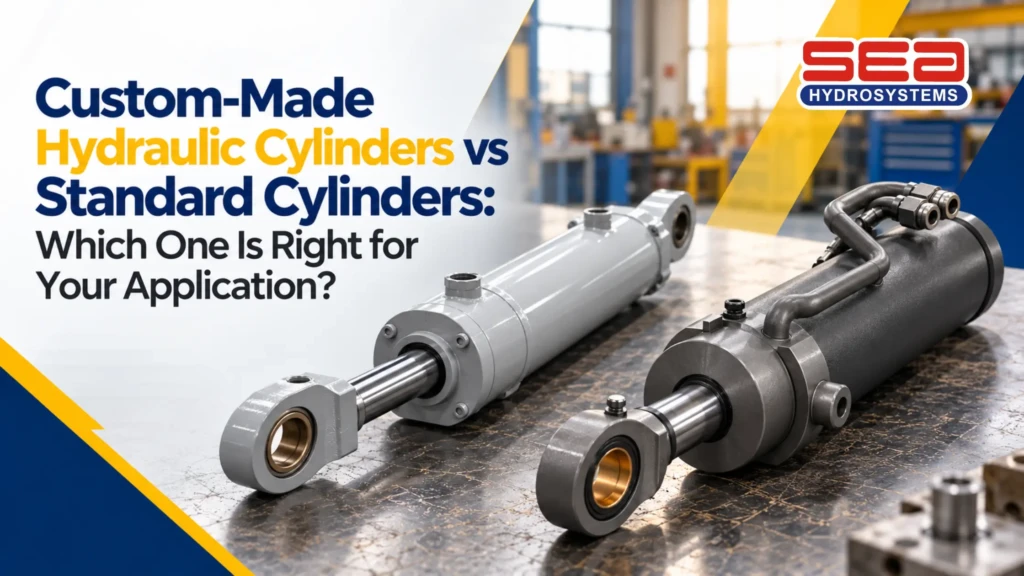
When specifying hydraulic components, engineers often need to decide between standard, off-the-shelf cylinders and custom made hydraulic cylinders designed for specific equipment requirements. Both options can be suitable, but the right choice depends on factors such as load, stroke, pressure, mounting configuration, installation space, operating environment, lead time, and budget.
A standard cylinder can be an efficient solution when an existing configuration meets the application’s requirements. A custom cylinder can provide greater flexibility when standard dimensions or specifications do not provide the required fit or performance.
At SEA Hydrosystems, we manufacture hydraulic cylinders for industrial, mobile, and specialized equipment applications, helping customers select solutions based on their actual operating requirements.
What Are Standard Hydraulic Cylinders?
Standard hydraulic cylinders are manufactured using commonly available bore sizes, stroke lengths, mounting configurations, and other specifications. They are designed for a broad range of general-purpose applications.
Standard cylinders can be suitable for:
- General industrial machinery
- Material handling equipment
- Agricultural machinery
- Construction equipment
- Replacement applications
- Equipment with established cylinder dimensions
The main advantages are relatively straightforward sourcing, established specifications, and potentially shorter lead times.
However, a standard cylinder may not be suitable when the equipment has restricted installation space, unusual mounting requirements, specialized operating conditions, or other application-specific requirements.
What Are Custom Made Hydraulic Cylinders?
Custom made hydraulic cylinders are designed around the requirements of a particular application. Depending on the project, customization can include bore diameter, rod diameter, stroke length, mounting configuration, port location, seals, materials, coatings, and other design features.
Custom cylinders are particularly useful when:
- Installation space is restricted
- A specific stroke length is required
- Mounting dimensions are unusual
- The cylinder operates under demanding loads
- The application has a high duty cycle
- Specialized seals or materials are required
- The equipment operates in harsh environments
The purpose of customization is to ensure that the cylinder integrates correctly with the equipment and performs reliably under actual operating conditions.
Working with experienced custom hydraulic cylinder manufacturers can help ensure that bore, stroke, mounting, sealing, and material requirements are considered during the design process.
For additional industry perspective on the differences between catalog and custom-built options, see this comparison of standard and custom-made cylinders.
Standard vs Custom Made Hydraulic Cylinders: Key Differences
Fit and Installation
One of the most important differences is dimensional flexibility.
Standard cylinders are available in predefined configurations. If their dimensions do not match the equipment, modifications or adapters may be necessary.
Custom made hydraulic cylinders can be designed around the available installation space. Important dimensions can include:
- Bore diameter
- Rod diameter
- Stroke length
- Retracted length
- Extended length
- Mounting dimensions
- Port location
- Rod-end configuration
This can be particularly useful when replacing an existing cylinder in equipment with limited space.
Load and Performance
Cylinder selection should consider the actual force, pressure, stroke, speed, and duty cycle required by the equipment.
Bore diameter influences available cylinder force, while rod diameter affects mechanical strength and resistance to loading conditions. Stroke length and operating speed also influence cylinder design and hydraulic flow requirements.
For applications with unusual load profiles or demanding operating cycles, custom made hydraulic cylinders can be designed around the actual requirements rather than forcing the equipment to use a standard configuration.
Mounting Configuration
A cylinder must be mounted correctly to support the required movement and minimize unwanted side loading or bending forces.
Common mounting arrangements include:
- Clevis mounts
- Flange mounts
- Trunnion mounts
- Foot mounts
- Pivot connections
- Specialized rod-end configurations
When the required mounting arrangement is not available in an existing cylinder, customization can provide a better solution.
Proper mounting and alignment can also help reduce side loading and premature wear. For additional information, see this guide to cylinder mounting considerations.
Seals, Materials, and Environment
Operating conditions can also influence cylinder selection.
Applications involving high temperatures, moisture, chemicals, abrasive materials, or corrosive environments may require specific seal materials, rod finishes, coatings, or construction materials.
With custom made hydraulic cylinders, these requirements can be considered during the design process.
Cost and Lead Time Considerations
Cost should not be evaluated only by comparing the initial cylinder purchase price.
Standard hydraulic cylinders generally offer a lower initial cost when the available specifications already match the application. They can also be easier to source for common replacement requirements.
Custom cylinders may require additional engineering, design, manufacturing, and testing. This can increase the initial investment and lead time.
However, a custom cylinder may reduce costs associated with:
- Equipment modifications
- Additional adapters
- Installation difficulties
- Premature component wear
- Repeated replacements
- Unplanned downtime
For this reason, engineers should consider total cost of ownership, not just the initial purchase price.
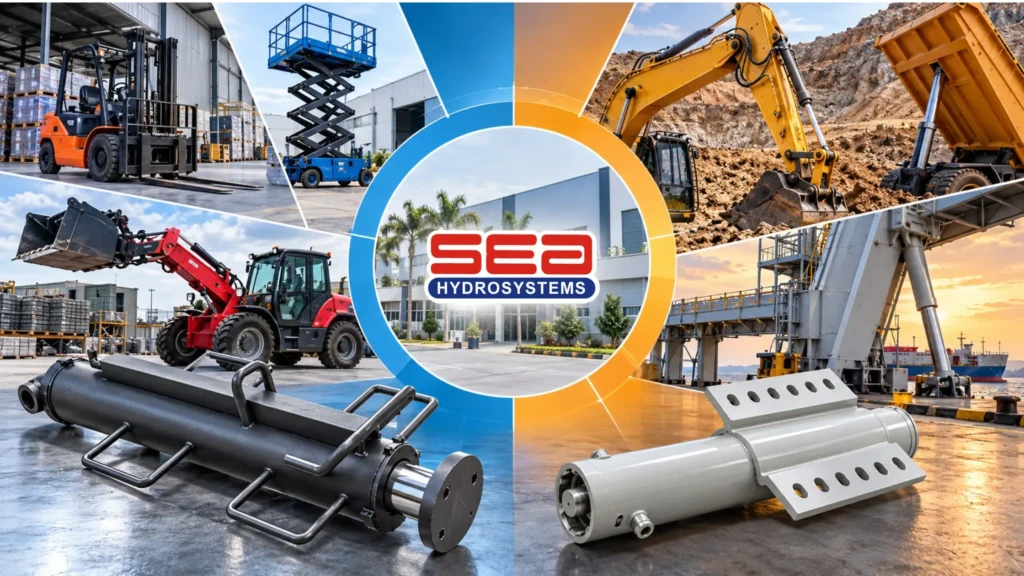
When to Choose Standard Hydraulic Cylinders
Standard hydraulic cylinders may be appropriate when:
- The available bore and stroke meet the requirements
- Mounting dimensions match the equipment
- Operating pressure is within the required range
- Environmental conditions are conventional
- Replacement availability is important
- The project has a short lead time
- Equipment modifications are unnecessary
- The application does not require specialized customization
For straightforward applications, a standard solution can simplify sourcing, installation, maintenance, and future replacement.
When to Choose Custom-Made Hydraulic Cylinders
Custom made hydraulic cylinders may be more suitable when:
- Installation space is limited
- A non-standard stroke is required
- Bore or rod dimensions need to be specific
- Mounting arrangements are unusual
- The equipment operates at a high cycle rate
- Specialized seals are required
- The application involves extreme temperatures
- Corrosive or abrasive conditions are present
- The cylinder must integrate precisely into OEM equipment
- Standard cylinders require significant equipment modifications
The key consideration is whether an available cylinder can meet the application’s requirements without compromising installation, performance, or reliability.
How to Select the Right Hydraulic Cylinder
Before selecting a cylinder, engineers should define the actual operating conditions of the equipment.
1. Load Requirements
Determine the required push and pull forces and identify the maximum expected load.
2. Stroke Length
Confirm the required cylinder travel and available retracted and extended space.
3. Operating Pressure
Ensure the selected cylinder is appropriate for the hydraulic system’s operating pressure and expected pressure conditions.
4. Operating Speed
Cylinder speed affects hydraulic flow requirements, seal performance, heat generation, and overall system operation.
5. Duty Cycle
A cylinder used occasionally may have very different requirements from one operating continuously across multiple shifts.
6. Mounting and Alignment
Confirm mounting dimensions and ensure that the installation does not introduce excessive side loading or misalignment.
7. Environmental Conditions
Consider temperature, moisture, dust, chemicals, corrosion, and other environmental factors that may affect seals and cylinder materials.
8. Maintenance Requirements
Consider access to seals, ports, mounting components, and other serviceable parts when selecting the cylinder configuration.
Custom hydraulic cylinder manufacturers can also review load, speed, duty cycle, and environmental conditions before recommending a suitable configuration.
Standard vs Custom: Quick Comparison
| Factor | Standard Cylinders | Custom Cylinders |
| Availability | Generally faster | Requires engineering and production |
| Initial cost | Usually lower | Usually higher |
| Dimensional flexibility | Limited | High |
| Mounting options | Standard configurations | Application-specific |
| Seals/materials | Standard options | Can be specified |
| Installation | Easier when standardized | Application-specific |
| OEM integration | Suitable for conventional designs | Suitable for specialized designs |
| Harsh environments | May have limitations | Greater design flexibility |
Does Custom Always Mean Completely Unique?
Not necessarily.
A custom cylinder does not have to be completely different from an established design. In many applications, only specific features need to be customized.
For example, customization may be limited to:
- Stroke length
- Bore or rod diameter
- Mounting dimensions
- Port position
- Seal selection
- Rod coating
- Rod-end configuration
Using proven design elements while customizing only the required features can provide application-specific integration without unnecessary engineering complexity.
Standard or Custom for OEM Equipment?
For OEM equipment, the choice depends on production volume, design requirements, service strategy, and integration needs.
Standard cylinders can simplify sourcing when the equipment is already designed around commonly available dimensions.
Custom cylinders may be preferable when an OEM requires a specific installation envelope, specialized mounting arrangement, environmental protection, or application-specific performance.
For OEM projects, custom hydraulic cylinder manufacturers can help align cylinder dimensions and performance requirements with the equipment design.
Future replacement should also be considered. A clearly documented cylinder specification can make maintenance and future sourcing easier.
Working With Custom Hydraulic Cylinder Manufacturers
Experienced custom hydraulic cylinder manufacturers can help evaluate whether customization is actually necessary.
The evaluation may include:
- Load and force requirements
- Bore and rod dimensions
- Stroke
- Operating pressure
- Speed
- Duty cycle
- Mounting configuration
- Seal requirements
- Environmental conditions
- Installation limitations
This application-based approach can help prevent unnecessary customization while ensuring that the selected cylinder is suitable for the equipment.
Custom Hydraulic Cylinder Solutions from SEA Hydrosystems
SEA Hydrosystems manufactures hydraulic cylinders for industrial, mobile, and specialized equipment applications.
Our engineering team can evaluate requirements such as load, stroke, pressure, mounting configuration, duty cycle, environmental conditions, and installation space.
Whether your project requires a standard configuration or custom made hydraulic cylinders, the selection should be based on the actual operating requirements of the equipment.
Explore our custom hydraulic cylinder solutions to discuss your application requirements.
Need the Right Cylinder for Your Application?
Choosing between standard and custom cylinders starts with understanding the equipment’s actual requirements.
SEA Hydrosystems can help evaluate your application and determine whether a standard configuration is suitable or whether a customized solution would provide the required fit and performance.
Contact our team to discuss your requirements:
sales@seahydrosys.com

