


Selecting the right reliable hydraulic cylinder company is an important decision for OEMs and industrial equipment manufacturers. Hydraulic cylinders directly affect machine movement, force, reliability, operating life, and maintenance requirements. Choosing a supplier only because of a low price can create problems if the cylinder does not match the application or production requirements.
A reliable supplier should provide more than a finished component. It should understand the application, support engineering requirements, maintain consistent manufacturing quality, meet delivery schedules, and provide technical support when required.
For OEM projects, these factors become even more important because cylinders may need specific dimensions, mounting configurations, pressure ratings, stroke lengths, materials, and sealing arrangements.
At SEA Hydrosystems, hydraulic cylinder solutions are available for OEM and industrial applications, including customized requirements.
Why Choosing the Right Hydraulic Cylinder Company Matters
Hydraulic cylinders are critical components in construction equipment, agricultural machinery, material-handling equipment, industrial machines, and many other hydraulic systems.
The wrong supplier or poorly specified cylinder can result in:
- Hydraulic leakage
- Premature seal wear
- Rod damage
- Installation problems
- Machine downtime
- Increased maintenance costs
- Production delays
- Reduced equipment reliability
The right supplier should understand the complete application rather than focusing only on individual cylinder dimensions.
For OEM customers, supplier consistency is also important. Cylinders supplied across multiple production batches should maintain the required dimensions, performance, and quality standards.
What to Look for in a Hydraulic Cylinder Company
1. Engineering and Design Support
Engineering capability should be one of the first factors to evaluate when selecting a supplier.
A cylinder should be selected based on the application, not only by bore and stroke. Important factors include:
- Required force
- Working pressure
- Bore diameter
- Rod diameter
- Stroke length
- Retracted length
- Mounting configuration
- Port size and location
- Operating speed
- Duty cycle
- Load direction
- Operating temperature
- Hydraulic fluid
- Environmental conditions
A capable hydraulic cylinder company should be able to discuss these requirements with the customer’s engineering team.
For example, long-stroke applications may require careful consideration of rod diameter and alignment. Applications involving pivoting movement may require suitable mounting arrangements, while harsh environments may require appropriate seals, materials, or surface treatments.
For OEM hydraulic cylinders, early engineering collaboration helps ensure that the design matches the machine’s load, stroke, mounting, and operating requirements.
Early engineering discussions can help identify potential problems before the cylinder reaches production.
2. Manufacturing Capabilities
Manufacturing capability is another important factor when comparing hydraulic cylinder manufacturers.
Ask whether the supplier has appropriate capabilities for machining, component preparation, assembly, inspection, and testing.
Depending on the design, manufacturing processes may include:
- Tube preparation and honing
- Rod machining
- Piston machining
- Gland machining
- Welding
- Threading
- Seal installation
- Cylinder assembly
- Pressure testing
- Dimensional inspection
In-house manufacturing can provide better control over important production stages. It can also make it easier to manage engineering changes and production requirements.
However, equipment alone does not guarantee quality. Ask about documented processes, inspection procedures, trained personnel, and production controls.
Quality Assurance and Testing
Quality control should be a major part of supplier evaluation. Before selecting a supplier, ask about its inspection and testing procedures. Depending on the cylinder and application, these may include:
- Dimensional inspection
- Bore and rod inspection
- Component inspection
- Seal inspection
- Assembly inspection
- Pressure testing
- Leakage testing
- Functional testing
For OEM projects, consistency is particularly important. A cylinder that performs correctly during prototype testing should also be manufactured consistently during production.
When comparing hydraulic cylinder manufacturers, review their inspection procedures, testing capabilities, and ability to maintain consistent quality across production batches.
Documentation and Traceability
Ask what documentation the supplier can provide. Depending on project requirements, this may include:
- Material certificates
- Inspection reports
- Test reports
- Product specifications
- Drawing revisions
- Part identification
- Traceability information
Clear documentation can help OEMs maintain their own quality-control and production records.
Experience With OEM Projects
OEM requirements are different from one-time replacement orders.
OEM customers may require prototypes first and then regular production quantities over an extended period. The supplier should therefore understand engineering collaboration, drawing revisions, quality documentation, repeat orders, and production planning.
When evaluating a supplier for OEM hydraulic cylinders, consider whether it can:
- Review engineering drawings
- Manufacture according to customer specifications
- Support prototype development
- Manage engineering revisions
- Maintain production consistency
- Support repeat orders
- Increase production when demand grows
A supplier with relevant OEM experience can make communication between engineering, purchasing, and production teams easier.
Customization Capability
Not every application can use a standard cylinder.
A machine may have limited installation space, unusual mounting requirements, a non-standard stroke, or specific operating conditions.
When evaluating a hydraulic cylinder company, ask whether it can customize:
- Bore diameter
- Rod diameter
- Stroke
- Retracted length
- Mounting style
- Port configuration
- Rod-end configuration
- Seals
- Materials
- Surface treatment
- Cushioning
Customization does not always mean designing a completely new cylinder. In some applications, a standard design can be modified to meet specific requirements.
Power & Motion Tech explains that the decision between standard and custom cylinders depends on application requirements such as dimensions, mounting, ports, materials, and operating conditions. See its comparison of standard and custom-made cylinders.
SEA Hydrosystems provides custom hydraulic cylinder solutions for application-specific requirements.
Evaluate the Cylinder Based on the Application
A reliable supplier should understand how the cylinder will operate inside the equipment.
Load and Force
The cylinder must provide the required push or pull force for the application. The supplier should understand the expected load and operating conditions before recommending the cylinder.
Pressure
Working and maximum pressure should be considered when selecting the cylinder. The cylinder should be suitable for the hydraulic system’s operating conditions.
Stroke
The stroke should provide the required movement without creating unnecessary travel or installation problems.
Operating Speed
Cylinder speed affects hydraulic flow requirements and can influence seal and cushioning requirements.
Duty Cycle
A cylinder used occasionally may have different requirements from one that operates continuously throughout multiple shifts.
Environment
Consider whether the cylinder will operate in:
- Dust
- Moisture
- Outdoor conditions
- High or low temperatures
- Corrosive environments
- Washdown conditions
These factors can affect material, coating, and seal selection.
For additional selection guidance, Fluid Power World highlights factors such as cylinder type, mounting, rod diameter, bore, pressure, seals, and operating conditions in its cylinder selection guide.
Consider Mounting and Alignment
Mounting configuration is an important part of cylinder selection.
Common mounting arrangements include:
- Clevis mounts
- Flange mounts
- Trunnion mounts
- Cross-tube mounts
- Foot mounts
- Side mounts
The mounting arrangement should match the movement and force direction of the machine.
Incorrect mounting or alignment can contribute to side loading, rod wear, bearing damage, seal wear, and premature cylinder failure.
Power & Motion Tech explains that proper mounting should be matched to the application’s force transfer and movement requirements. Its guide to choosing the right cylinder mount provides additional technical guidance.
When requesting a quotation, provide mounting drawings or dimensional information whenever possible. This allows the supplier to verify that the proposed cylinder will fit correctly within the machine.
Materials, Seals, and Surface Protection
Material and seal selection should match the operating environment.
A supplier should be able to discuss suitable options for:
- Cylinder barrel
- Piston
- Rod
- Rod surface treatment
- Bearings
- Seals
- Wipers
For applications exposed to moisture or corrosive conditions, surface protection may require additional consideration.
Seal selection should also take into account hydraulic fluid, temperature, pressure, operating speed, and duty cycle.
The supplier should be able to explain why a particular material or seal configuration is suitable for the application.
Lead Time and Production Capacity
Price should not be the only consideration when selecting a supplier.
For OEM manufacturers, delayed cylinder deliveries can affect the assembly and delivery of the complete machine.
Before selecting a supplier, ask about:
- Prototype lead time
- Production lead time
- Repeat-order lead time
- Production capacity
- Material availability
- Minimum order quantities
- Delivery planning
Experienced hydraulic cylinder manufacturers should be able to support both prototype requirements and repeat production while maintaining agreed quality and delivery schedules.
Production capacity is also important when an OEM expects future growth. The supplier should be capable of supporting both current and increased production requirements without compromising quality.
Communication and Technical Support
Good communication can prevent many problems during an OEM project.
Projects may involve:
- Drawing changes
- Specification updates
- Prototype feedback
- Production forecasts
- Quality questions
- Delivery updates
- Installation issues
The supplier should have a clear process for handling technical communication and engineering changes.
Ask who will handle your account and who will be available for technical discussions. Quick and accurate communication can reduce delays during development and production.
Total Cost Instead of Purchase Price
The lowest unit price does not always represent the lowest overall cost.
Consider the complete cost of the cylinder, including:
- Purchase price
- Engineering support
- Shipping
- Installation
- Maintenance
- Replacement requirements
- Downtime
- Warranty costs
For example, a low-cost cylinder that requires frequent replacement may create higher costs over its operating life.
OEMs should therefore compare suppliers based on overall value, quality, reliability, support, and production consistency.
Scalability for OEM Production
A supplier may be able to manufacture prototypes but struggle when production volumes increase.
For OEM applications, consider whether the supplier can support the complete development cycle:
Prototype → Testing → Approval → Pilot Production → Regular Production
During prototype development, engineering support is important. During regular production, consistency, capacity, cost control, and delivery become increasingly important.
A supplier producing OEM hydraulic cylinders should also have the capacity to maintain consistent specifications as production volumes increase.
The supplier should be able to support the project as production requirements change.
After-Sales Support and Warranty
Supplier support should continue after the cylinder is delivered.
Before selecting a supplier, ask how it handles:
- Technical questions
- Product issues
- Warranty claims
- Replacement requirements
- Seal or component requirements
- Engineering changes
- Non-conforming products
Good after-sales support can be particularly valuable when cylinders are installed in machines operating under demanding conditions.
Understanding the supplier’s warranty and support process before placing an order can prevent confusion later.
Questions to Ask Before Choosing a Supplier
Before selecting a supplier, OEM and industrial purchasing teams can ask:
- Do you have experience with similar applications?
- Can your engineering team review our requirements?
- What cylinder types can you manufacture?
- What manufacturing processes are handled in-house?
- What quality inspections and tests are performed?
- Can you provide inspection and test documentation?
- Can you support prototype and production quantities?
- What customization options are available?
- How are engineering revisions managed?
- What are your typical production lead times?
- Can you support increased production volumes?
- What after-sales and warranty support do you provide?
These questions help buyers evaluate suppliers using consistent criteria instead of comparing only prices.
Information to Provide When Requesting a Quote
Providing complete information can help the supplier understand the requirement accurately.
Whenever possible, provide:
Cylinder Requirements
- Bore diameter
- Rod diameter
- Stroke
- Retracted length
- Mounting dimensions
- Port size and location
Hydraulic Requirements
- Working pressure
- Maximum pressure
- Hydraulic fluid
- Operating temperature
- Required speed
- Duty cycle
Mechanical Requirements
- Push or pull load
- Load direction
- Mounting arrangement
- Available installation space
- Operating environment
Production Requirements
- Prototype quantity
- Expected annual quantity
- Required delivery date
- Documentation requirements
For OEM hydraulic cylinders, providing complete application and production information at the quotation stage can help the supplier evaluate the design and plan manufacturing requirements more accurately.
Providing this information at the beginning can reduce unnecessary communication and help the supplier prepare a more accurate proposal.
Standard vs. Custom Cylinders
Not every application requires a completely custom design.
Standard cylinders may be suitable when:
- Dimensions already match the equipment
- Standard stroke lengths are available
- Mounting configuration is suitable
- Operating conditions are within standard specifications
- Interchangeability is important
Custom cylinders may be suitable when:
- Installation space is restricted
- Mounting dimensions are unusual
- A non-standard stroke is required
- Special seals are needed
- Environmental conditions are demanding
- The cylinder must integrate with a new machine design
The supplier should help determine whether a standard, modified, or custom solution is appropriate.
Partnering With SEA Hydrosystems
SEA Hydrosystems supports OEM and industrial customers with hydraulic cylinder solutions designed around application requirements.
For projects requiring specific dimensions, mounting arrangements, stroke lengths, materials, or other application requirements, SEA Hydrosystems can support customized cylinder requirements.
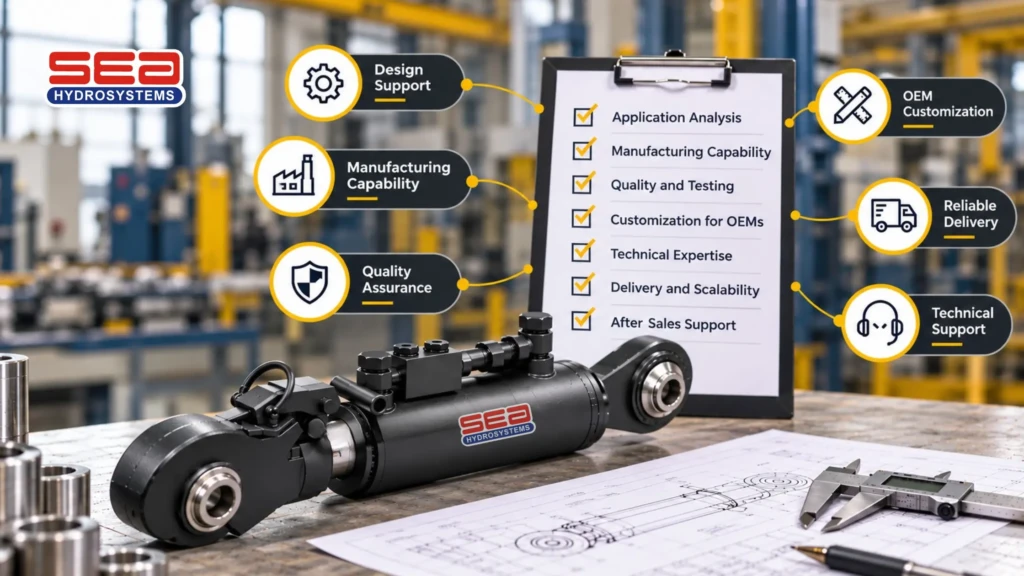
Choosing a supplier should be based on more than product price. Engineering support, manufacturing capability, quality control, customization, delivery, communication, and after-sales service should all be considered.
For OEM projects, a supplier that can support both development and ongoing production can help create a more consistent and reliable supply relationship.
Conclusion
Choosing a reliable hydraulic cylinder company requires a complete evaluation of the supplier and its capabilities.
The most important factors include engineering support, manufacturing capability, quality assurance, OEM experience, customization, lead time, production capacity, communication, and after-sales support.
When comparing hydraulic cylinder manufacturers, consider whether the supplier can meet your current requirements while also supporting future production needs.
For OEM hydraulic cylinders, application fit and production consistency are especially important because the cylinder becomes an integral part of the final machine.
By evaluating suppliers based on technical capability, quality, reliability, communication, and total value, OEMs and industrial companies can make a more informed purchasing decision and build stronger long-term supplier relationships.
Looking for a Reliable Hydraulic Cylinder Partner?
SEA Hydrosystems supports OEM and industrial customers with standard and customized hydraulic cylinder solutions.
Contact our team to discuss your cylinder requirements.

