


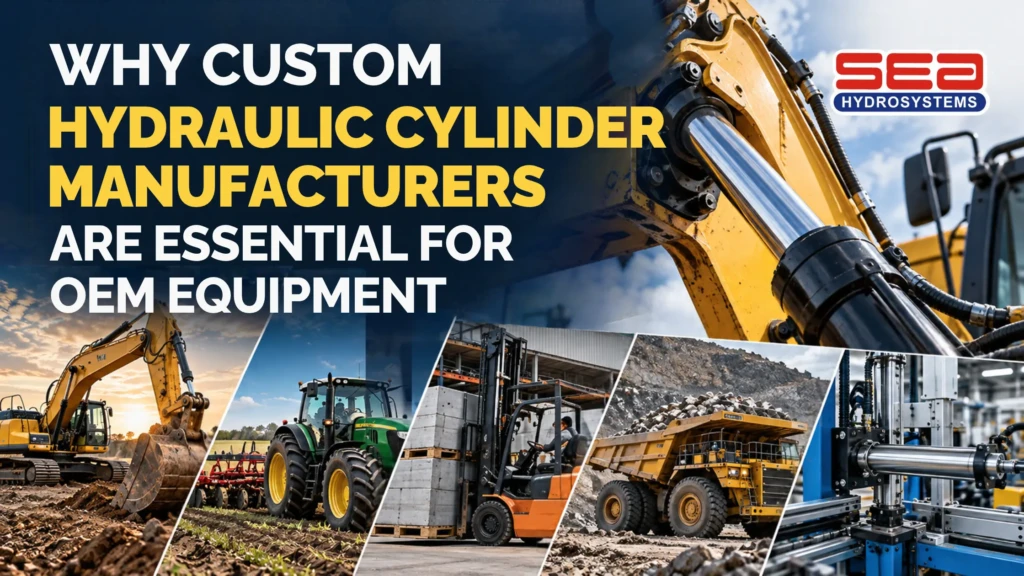
Original Equipment Manufacturers (OEMs) design machinery to meet specific operating requirements, performance targets, and production goals. A construction machine may need to generate substantial force in demanding outdoor conditions, while an agricultural implement may require reliable movement through repeated operating cycles. Industrial automation equipment, on the other hand, may depend on precise positioning, compact installation dimensions, and consistent performance.
Hydraulic cylinders convert hydraulic energy into linear movement. Their dimensions, mounting arrangements, stroke length, pressure requirements, and operating characteristics must match the equipment in which they are installed. A component that performs adequately in one application may not be suitable for another machine with different loads, space restrictions, or duty-cycle requirements.
Standard products can meet many common requirements. However, when a machine design introduces specific engineering constraints, custom hydraulic cylinders may offer a more suitable solution. Working with custom hydraulic cylinder manufacturers can help OEM engineering teams coordinate specifications, evaluate prototypes, manage revisions, and prepare for repeatable production.
The objective is not simply to manufacture a cylinder with different dimensions. It is to develop a component that integrates with the complete machine, meets agreed technical requirements, and can be manufactured consistently as the equipment moves from development to production.
This article explains how cylinder development fits into the OEM product lifecycle, why engineering coordination matters, how validation and change control support production, and what information OEMs should prepare before starting a project.
Understanding the OEM Design Challenge
OEM product development involves multiple engineering decisions that influence one another. A change to the machine’s frame, linkage, hydraulic circuit, or installation space can affect the cylinder specification. Similarly, changing the cylinder’s stroke or mounting points may require adjustments to the surrounding equipment.
Before finalizing a cylinder design, the project team should understand the machine’s intended movement and the loads the cylinder must handle. These requirements influence bore diameter, rod dimensions, stroke length, operating pressure, mounting configuration, and other design considerations.
The cylinder must also fit within the machine’s physical envelope. Engineers need to consider its retracted and extended lengths, clearance throughout the movement path, connection points, hose routing, and access for installation or servicing.
Operating conditions introduce additional considerations. Temperature, moisture, dust, vibration, corrosion exposure, hydraulic-fluid compatibility, and the expected operating cycle can influence component selection and design decisions.
When these factors are considered too late, an OEM may face redesign work, production delays, installation problems, or additional validation. Early technical coordination helps the engineering team identify constraints before the equipment design is released for manufacturing.
When Custom Hydraulic Cylinders Make Sense
A standard cylinder should not automatically be ruled out. If an available product meets the required dimensions, performance, operating conditions, and documentation needs, it may be a practical and economical choice.
Customization becomes relevant when a standard configuration cannot adequately satisfy one or more essential requirements.
Common situations include:
- Restricted installation space: The equipment layout requires specific overall dimensions or a compact arrangement.
- Non-standard stroke requirements: The required linear movement does not match available standard configurations.
- Special mounting interfaces: The cylinder must connect to a particular frame, linkage, or moving assembly.
- Defined operating conditions: The load, pressure, duty cycle, or environment requires an application-specific engineering review.
- Equipment-platform requirements: Different machine models need coordinated configurations based on approved engineering specifications.
- Production or documentation needs: The OEM requires controlled drawings, part identification, inspection records, or revision management.
Customization should solve a defined engineering problem. It should not add complexity without a corresponding benefit. The OEM should compare the proposed configuration with suitable standard alternatives before approving development.
1. How Custom Hydraulic Cylinder Manufacturers Support OEM Development
A successful cylinder project requires more than a drawing and a purchase order. It involves translating the OEM’s application requirements into a specification that can be reviewed, manufactured, inspected, and approved.
Early engineering collaboration
Engaging the manufacturing team during the design stage allows technical questions to be resolved before they become production problems. The OEM can share available drawings and application information, while the supplier can identify missing specifications or potential manufacturing constraints.
Early discussions may cover:
- Available installation space and dimensional limits
- Required force, load conditions, and stroke
- Operating pressure and expected movement
- Mounting interfaces and connection locations
- Environmental exposure and hydraulic-fluid requirements
- Expected operating frequency and service conditions
- Inspection, testing, and documentation expectations
The engineering teams should also agree on which requirements are mandatory and which may allow alternatives. This distinction helps avoid unnecessary redesign and gives the project a clear basis for technical decisions.
Design review and specification approval
Before manufacturing begins, the parties should confirm the agreed configuration. The specification should identify the relevant dimensions, interfaces, materials where specified, operating requirements, and acceptance criteria.
Drawings should have identifiable revision numbers and approval status. This reduces the risk of different departments working from conflicting versions.
The OEM should review the design in the context of the complete machine, rather than assessing the cylinder in isolation. Clearance, attachment movement, hydraulic connections, and access for installation should all be considered.
Prototype development and validation
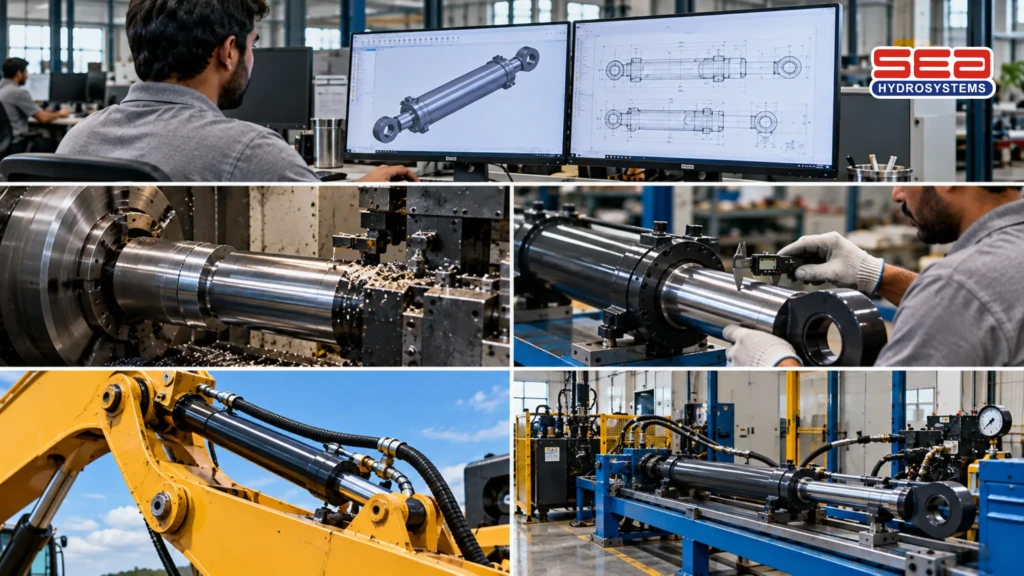
A prototype gives the OEM an opportunity to evaluate the proposed design before committing to regular production. The amount of testing depends on the project’s risk, complexity, and agreed acceptance requirements.
Validation may include dimensional inspection, functional checks, leakage checks, pressure testing, and evaluation of the cylinder’s integration with the equipment. Where necessary, the OEM may also conduct machine-level trials under defined operating conditions.
Testing should be performed by qualified personnel using suitable equipment and documented procedures. Acceptance criteria should be agreed before testing begins so that the results can be assessed objectively.
If a prototype does not meet a requirement, the team should record the issue, determine its cause, approve any necessary design changes, and repeat the relevant checks. This creates a clear path from prototype evaluation to production approval.
For additional technical context, OEM engineering teams can review this research on application-specific engineering design, which examines a cylinder design for a CNC machine clamping application.
Production readiness
Prototype approval does not automatically mean that a design is ready for unrestricted production. The project team should confirm that drawings, materials, manufacturing processes, inspection requirements, and delivery expectations are understood.
A production-readiness review can help answer several important questions:
- Has the final drawing been approved?
- Are the required materials and components available?
- Are the inspection and testing criteria documented?
- Can the planned production quantity be supported?
- Are product identification and revision details clear?
- Have outstanding prototype issues been resolved?
- Are delivery dates and packaging requirements agreed?
Resolving these points before production begins helps reduce avoidable interruptions.
2. Engineering Requirements for OEM Hydraulic Cylinders
The cylinder specification should be based on the intended machine function, not simply copied from an existing component without reviewing the application.
Force and operating pressure
The required force is an important input to cylinder sizing. For an idealized extension stroke, the force produced by hydraulic pressure is related to the effective piston area. Actual performance must also account for system losses, mechanical loading, operating conditions, and applicable design requirements.
The OEM should provide the expected load conditions and the system’s intended operating pressure. Engineers can then evaluate whether the proposed dimensions and configuration are suitable.
Stroke and movement
Stroke length defines the distance the piston rod travels between its retracted and extended positions. The selected stroke must provide the required machine movement without creating interference or exceeding mechanical travel limits.
The full movement path should be reviewed, including clearances at both ends and the relationship between the cylinder and connected components.
Mounting and mechanical interfaces
The mounting arrangement affects how loads are transferred between the cylinder and the machine. Mounting points, alignment, attachment geometry, and available movement should be assessed as part of the design review.
Poor alignment or unsuitable mechanical interfaces can create unwanted side loading and may affect component life. The complete assembly should therefore be evaluated rather than relying on dimensional compatibility alone.
Hydraulic connections and installation
Port positions and connection arrangements should support practical installation and suitable hose routing. The design review should consider nearby components, movement during operation, and access for assembly and inspection.
These details may appear small on a drawing, but they can have a significant effect on production and serviceability.
Environmental and operating conditions
The intended environment should be clearly documented. Temperature range, moisture, contamination, corrosion exposure, operating frequency, and hydraulic-fluid characteristics may influence design decisions.
No single configuration is appropriate for every application. The final specification should be reviewed against the machine’s real operating conditions and applicable engineering requirements.
3. Maintaining Consistency During Production
Once a design has been approved, the next challenge is producing the same specified component across the required quantity and schedule. This is particularly important for OEMs manufacturing equipment in batches or across multiple production locations.
Consistency begins with controlled specifications. The manufacturing team should have access to the approved drawings, relevant material requirements, inspection criteria, and revision information. Any change to these documents should follow an agreed approval process.
For OEM hydraulic cylinders supplied through recurring orders, production controls should help ensure that each batch follows the same approved specification unless a documented revision has been authorized.
Approved drawings and revision control
Each production configuration should be identifiable. Part numbers and drawing revisions help purchasing, engineering, manufacturing, and quality teams distinguish approved versions.
If a drawing changes, the team should clarify when the revised version takes effect and how work already in progress will be handled. This prevents older specifications from being used unintentionally.
Inspection and test records
Inspection requirements should be proportionate to the application and agreed quality criteria. Depending on the project, records may include dimensional measurements, material documentation, functional checks, and test results.
Records help the OEM determine whether the delivered product conforms to the approved specification. They can also support investigations if a quality issue is identified later.
Material and production planning
Material availability and component lead times can influence the delivery schedule. These factors should be discussed early, particularly when the design includes specified materials or components with longer procurement times.
Production planning should consider expected quantities, inspection time, packaging, transport, and any required customer approvals. A realistic schedule is more useful than a delivery promise that does not account for these activities.
Batch-to-batch repeatability
For recurring orders, the OEM and supplier should establish how the approved specification will be maintained. Relevant controls may include consistent documentation, inspection procedures, part identification, and records of authorized changes.
Repeatability is not guaranteed by using the same part number alone. It depends on the manufacturing and quality processes used to keep production aligned with the approved requirements.
4. Managing Engineering Changes Across the Product Lifecycle
OEM equipment can change after the first design is released. Customer feedback, field evaluations, component availability, cost targets, or updates to the machine platform may create a need for revisions.
A structured change-management process helps ensure that these updates are assessed before they affect production.
Document the change request
Every proposed change should be clearly described. The request may involve a dimensional adjustment, a mounting interface, a material requirement, a connection location, or a revised operating condition.
The team should identify the reason for the change and which equipment models or production batches may be affected.
Assess technical implications
Before approving a revision, the engineering team should assess its potential impact on fit, function, performance, safety, manufacturing, and service requirements.
A change that appears minor on a drawing may affect the surrounding assembly or require additional validation. The level of review should reflect the nature and risk of the change.
Approve and communicate the revision
The approved change should be recorded in the relevant drawings and documentation. Purchasing, production, quality, and service teams should receive the updated information.
The project should also identify how existing inventory and work in progress will be handled. Without this step, older and newer configurations may be mixed unintentionally.
Revalidate where necessary
Some revisions require additional inspection or testing before production release. The team should determine which previous approvals remain valid and which checks need to be repeated.
For OEMs managing several machine models, a controlled change process helps preserve configuration clarity throughout the product lifecycle.
5. Planning Capacity, Lead Times, and Deliveries
The cylinder development schedule must fit within the wider equipment-development plan. Delays in specification approval, prototype evaluation, material procurement, or production can affect machine assembly and customer delivery.
A realistic plan should separate the major project stages rather than treating the entire process as one manufacturing lead time.
Define the project milestones
Typical milestones include requirement confirmation, drawing review, design approval, prototype completion where required, validation, production release, manufacturing, inspection, and dispatch.
The sequence may differ depending on the complexity of the application. The supplier and OEM should agree on the milestones that apply to the specific project.
Confirm quantity and demand forecasts
Expected order quantities influence material planning and production scheduling. OEMs should communicate the initial requirement and, where possible, anticipated demand for later orders.
Forecasts are not the same as confirmed purchase orders, so the parties should clarify which quantities are committed and which are estimates.
Identify dependencies and risks
The delivery plan should account for activities that could affect timing. These may include pending technical approvals, specialized material procurement, prototype changes, testing requirements, or incomplete application information.
Discussing dependencies early gives the team a chance to resolve them before they disrupt production.
Agree on communication and escalation
A project contact should be identified for technical questions, drawing approvals, delivery updates, and issue resolution. The team should also agree how urgent concerns will be escalated.
Clear communication does not eliminate every delay, but it makes it easier to identify risks and coordinate an appropriate response.
6. Evaluating the Total Project Cost
The initial component price is only one part of the OEM’s cost calculation. Engineering time, prototype work, testing, production quantity, installation effort, and delivery requirements can all affect the overall project economics.
Custom hydraulic cylinders may involve additional engineering or setup costs compared with an available standard product. Whether that investment is justified depends on the application and the value of solving the specific design problem.
When comparing proposals, OEMs should consider:
- Initial unit price and any engineering charges
- Prototype quantities and validation costs
- Materials and manufacturing complexity
- Required inspection and documentation
- Expected order volume and repeat-order needs
- Installation or equipment-modification requirements
- Delivery schedule and transportation
- Potential costs associated with design revisions
A lower initial price does not necessarily produce the lowest overall project cost if the proposed component requires additional adaptation or fails to meet the agreed requirements.
Equally, a customized solution should not be selected solely because it is more specialized. The OEM should compare technically suitable alternatives and determine whether the proposed design offers a measurable engineering or commercial benefit.
Complete application information can help suppliers prepare clearer quotations. Drawings, quantities, operating conditions, testing expectations, and target delivery dates should be shared as early as possible.
7. Quality Documentation and Traceability
Documentation connects the approved design with the component delivered to the OEM. It supports communication between engineering, procurement, manufacturing, quality, and service teams.
The documentation required will depend on the project. It may include:
- Approved technical drawings
- Part numbers and revision history
- Agreed material specifications
- Inspection criteria and records
- Relevant test reports
- Product identification details
- Approved deviations or engineering changes
Traceability means being able to identify relevant product or process records when required. Its scope should be agreed between the OEM and supplier rather than assumed to be identical for every project.
Clear documentation is particularly useful when the OEM manufactures multiple machine variants or places repeat orders over an extended period. It helps the team identify the correct approved configuration and investigate issues using consistent information.
Documentation should reflect the actual manufacturing and inspection process. It should not claim that a product has been tested, certified, or approved unless the relevant evidence exists.
8. Safety and Operational Requirements
Cylinder development must account for the wider hydraulic system and the machine in which the component will operate. The cylinder specification alone cannot establish the safety of the complete assembly.
OEM engineering teams should evaluate operating pressure, expected loads, mounting arrangements, movement limits, and the consequences of component failure. Relevant system-level requirements should be addressed by qualified personnel as part of the machine design and validation process.
Hydraulic systems can present hazards from stored energy, unexpected movement, pressurized fluid, and component failure. Appropriate installation, guarding, isolation, inspection, and maintenance procedures are important to managing these risks.
For background on hydraulic-system engineering, consult SAE International’s research on cylinder durability and manufacturability. This technical paper discusses engineering approaches related to cylinder design and manufacture.
The OSHA hydraulic-system safety bulletin also describes hazards associated with hydraulic systems and the importance of suitable maintenance practices.
These references provide technical context, but they do not replace application-specific engineering review or applicable regulations and standards. OEMs should define the required testing, safety controls, and maintenance procedures for their own equipment.
9. Information OEMs Should Prepare Before Requesting a Quotation
A clear request for quotation helps the supplier understand the application and identify any missing information before proposing a solution.
OEMs should prepare as much of the following information as is available.
Application details
- Equipment type and intended function
- Description of the movement the cylinder must provide
- Operating environment and expected duty cycle
Technical requirements
- Required bore, rod, and stroke dimensions, if known
- Operating pressure and load information
- Mounting points and available installation space
- Hydraulic-fluid and temperature requirements
- Connection and hose-routing constraints
Project requirements
- Expected prototype and production quantities
- Target delivery dates
- Inspection and testing expectations
- Required documentation
- Packaging and delivery arrangements
- Existing drawings, reference parts, or approved specifications
If some technical details are not yet finalized, the OEM should identify them as open items rather than presenting estimates as confirmed requirements. The engineering teams can then determine which information is essential before the design is approved.
When researching potential suppliers, OEMs can also consult an industrial supplier directory and market overview to understand available sourcing options. Directory listings are a starting point for research, not a substitute for checking a supplier’s capabilities, technical suitability, and quality processes directly.
10. Frequently Asked Questions
Why do OEMs work with specialist cylinder manufacturers?
OEMs may work with specialist manufacturers when standard products do not adequately match their equipment requirements or when the project needs coordinated engineering review, prototype validation, documentation, and production planning.
Are customized cylinders always better than standard products?
No. A standard product may be the most practical option when it meets the application’s dimensional, performance, operating, and documentation requirements. Customization is worth considering when a defined engineering need cannot be adequately addressed by a standard configuration.
What should be confirmed before prototype production?
The OEM and supplier should agree on the technical specification, drawing revision, required interfaces, acceptance criteria, and any planned testing. Outstanding assumptions should be documented before the prototype is manufactured.
How can an OEM reduce production delays?
Early requirement confirmation, timely drawing approvals, realistic delivery planning, clear communication, and controlled engineering changes can reduce avoidable delays. Material availability and project complexity should also be considered when setting the schedule.
What documentation may be needed?
Depending on the project, documentation may include approved drawings, revision records, material specifications, inspection results, test reports, and product identification details. The OEM and supplier should agree on the required documents before production.
Can the cylinder specification change after production begins?
Changes may be possible, but they should be assessed, approved, documented, and communicated through a controlled process. Depending on the revision, additional inspection or validation may be required before the updated configuration is released.
11. OEM Cylinder Development Support From SEA Hydrosystems
SEA Hydrosystems works with hydraulic cylinder requirements for industrial and OEM applications. For projects involving a specific equipment design, the initial discussion should establish the required application, dimensions, operating conditions, mounting interfaces, quantities, and any relevant quality or documentation expectations.
OEM teams can prepare their existing drawings and technical information to support a more focused project review. Where requirements are still being developed, clearly identifying open questions can help structure the next engineering discussion.
To review available solutions, visit the SEA Hydrosystems product range. For projects that
require application-specific configurations, the custom cylinder services page provides a relevant starting point.
The final specification and scope of work should be confirmed directly with the supplier for each project.
Conclusion
Hydraulic cylinders are an important part of many OEM machines, and their performance depends on how well the component matches the equipment’s design and operating conditions. Successful development therefore requires more than selecting dimensions or comparing unit prices.
Custom hydraulic cylinders can be useful when a standard configuration does not satisfy a defined application requirement. Early engineering coordination, clear specifications, prototype validation, controlled documentation, and realistic production planning help the OEM and supplier move from design to manufacturing with a shared understanding of the approved requirements.
Selecting OEM hydraulic cylinders should involve evaluating the complete application, the evidence required for approval, and the processes needed to maintain consistency across production batches. The right solution is the one that meets the agreed engineering requirements and makes practical sense for the equipment and its production plan.
For OEM projects, collaboration with custom hydraulic cylinder manufacturers can support this process by aligning technical requirements, manufacturing considerations, and project milestones from the beginning.
Need to discuss a cylinder requirement for your equipment?
Contact SEA Hydrosystems to discuss your OEM or industrial application.
Email: sales@seahydrosys.com

