


Every lift, tilt, and side-shift movement on a forklift depends on a properly functioning fork lift cylinder. These cylinders operate through repeated cycles and must provide controlled hydraulic movement for demanding material handling operations.
Understanding the different cylinder types, common failure points, wear factors, and maintenance practices can help fleet managers and maintenance teams reduce downtime and identify developing problems before they affect equipment performance.
A properly selected and maintained forklift hydraulic cylinder must withstand repeated loading, frequent cycling, varying operating conditions, and the demands of material handling applications.
At SEA Hydrosystems, we manufacture hydraulic cylinders for demanding material handling and industrial equipment applications.
Types of Forklift Hydraulic Cylinders
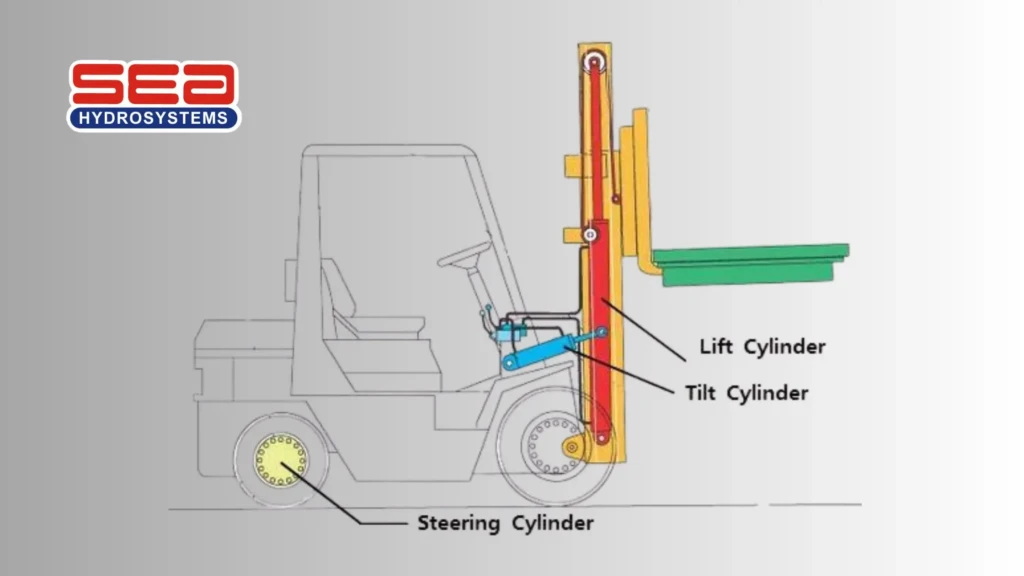
Forklifts use different hydraulic cylinders depending on the movement and function they need to perform. The cylinder design, dimensions, mounting arrangement, and operating specifications vary according to the application.
Lift Cylinders
Lift cylinders raise and lower the forklift mast and forks. They handle significant loads and may operate repeatedly throughout the working day.
A properly selected forklift hydraulic cylinder should match the required lifting capacity, stroke length, operating pressure, mounting configuration, and available installation space.
Lift-cylinder performance can also depend on proper alignment between the cylinder, mast, pins, bushings, and related components.
Tilt Cylinders
Tilt cylinders move the mast forward and backward. This movement helps operators position loads correctly and maintain appropriate load stability during handling.
Tilt-cylinder performance can be affected by seal condition, rod damage, mounting alignment, excessive loading, and hydraulic-system pressure.
Regular inspection can help identify leakage, abnormal movement, or mounting problems before they develop into more serious failures.
Side-Shift Cylinders
Side-shift cylinders move the forks horizontally from side to side, allowing operators to position loads without moving the entire forklift.
Because side-shift cylinders are compact and may operate frequently, correct sizing, mounting, stroke length, and regular inspection are important.
The cylinder should also be suitable for the operating pressure and environmental conditions of the forklift.
Common Forklift Cylinder Issues
A forklift hydraulic cylinder can develop problems because of wear, contamination, misalignment, excessive loading, damaged components, or inadequate maintenance.
Common issues include:
- Seal wear caused by repeated cycling
- Rod scoring, pitting, or corrosion
- Internal or external hydraulic fluid leakage
- Slow or uneven cylinder movement
- Cylinder drift caused by internal leakage
- Pin and bushing wear affecting alignment
- Damage caused by excessive side loading
- Reduced lifting or tilting performance
- Abnormal noise or movement during operation
These problems can develop gradually, making regular inspection important for identifying issues before they result in unexpected equipment downtime.
How Forklift Cylinder Wear Develops
Forklift cylinders operate under repeated loading and movement. Over time, this repeated cycling can contribute to wear of seals, rods, bearings, and mounting components.
Several operating conditions can accelerate cylinder wear, including:
- High daily cycle counts
- Contaminated hydraulic fluid
- Damaged or worn seals
- Misalignment
- Excessive side loading
- Harsh operating environments
- Improper lubrication of related mounting components
- Incorrect operating pressure
- Poor installation or alignment
Identifying the underlying cause of wear is important before replacing a fork lift cylinder, especially when the same failure occurs repeatedly.
Simply replacing a damaged cylinder without correcting the original cause can result in another premature failure.
Forklift Cylinder Maintenance Best Practices
Regular forklift cylinder maintenance helps identify leaks, wear, alignment problems, and performance changes before they lead to unexpected equipment downtime.
Recommended practices include:
- Inspect piston rods for scoring, pitting, corrosion, or physical damage
- Check for hydraulic fluid leaks around rod seals, ports, hoses, and connections
- Monitor hydraulic fluid level and cleanliness
- Inspect mounting pins, bushings, and connections
- Check for abnormal cylinder movement or drift
- Keep exposed rod surfaces clean
- Inspect cylinder mounting areas for signs of excessive movement
- Follow the equipment manufacturer’s recommended service intervals
- Investigate unusual changes in lifting or tilting performance
- Maintain accurate service and inspection records
For additional guidance on routine powered industrial truck inspections, see this forklift daily inspection checklist.
Consistent forklift cylinder maintenance can help improve cylinder reliability, reduce unexpected downtime, and support longer component service life.
How Duty Cycle Affects Forklift Cylinder Wear
Forklifts used in high-throughput warehouses, distribution centers, manufacturing facilities, and multi-shift operations can complete many more lift and tilt cycles than equipment used occasionally.
Higher cycle counts can increase wear on seals, rods, bearings, and other components.
For high-use fleets, forklift cylinder maintenance should be planned according to actual operating conditions rather than relying only on a fixed calendar schedule.
Monitoring operating hours, cycle frequency, leakage, and cylinder performance can help maintenance teams determine when additional inspection may be necessary.
Equipment operating in dusty, wet, corrosive, or otherwise harsh environments may also require more frequent inspection.
Hydraulic Fluid and Contamination Control
Hydraulic fluid condition has a direct impact on the performance of a forklift hydraulic cylinder.
Dirt, water, metal particles, and other contaminants can contribute to wear of seals, rods, valves, pumps, and other hydraulic components. Contaminated fluid can also reduce the reliability of the overall hydraulic system.
Good maintenance practices include:
- Keep hydraulic fluid clean
- Check fluid levels regularly
- Replace filters according to service requirements
- Prevent contaminants from entering the hydraulic reservoir
- Inspect hoses and fittings for damage
- Use the recommended hydraulic fluid for the equipment
- Investigate changes in cylinder performance
- Follow proper fluid handling and storage practices
Maintaining clean hydraulic fluid is an important part of forklift cylinder maintenance and can help reduce premature wear of hydraulic components.
Choosing the Right Replacement Cylinder
When replacing a fork lift cylinder, it is important to verify that the replacement matches the equipment’s actual requirements.
Consider the following:
- Bore diameter
- Rod diameter
- Stroke length
- Operating pressure
- Mounting configuration
- Port configuration
- Seal compatibility
- Overall retracted and extended dimensions
- Available installation space
- Operating environment
A replacement cylinder should not be selected based only on appearance or overall dimensions. Important internal, dimensional, and operating specifications should also be verified.
The correct cylinder should be capable of handling the required load and cycle conditions while fitting the existing equipment configuration.
When to Replace a Forklift Hydraulic Cylinder
Repairing or rebuilding a cylinder may be appropriate in some situations, while replacement may be more practical when damage is extensive or the cylinder no longer meets the application requirements.
Consider replacing a forklift hydraulic cylinder when:
- The piston rod has significant bending or surface damage
- Leakage continues after appropriate seal replacement
- The cylinder barrel or internal components are severely damaged
- Cylinder performance remains inconsistent after repair
- Repair costs approach the cost of a suitable replacement
- Repeated failures indicate the existing design is not appropriate for the application
- The cylinder no longer meets the required operating specifications
Before replacement, identify the cause of the failure to prevent the same problem from occurring with the new cylinder.
Importance of Proper Forklift Cylinder Maintenance
A structured forklift cylinder maintenance program should include regular inspection, fluid checks, mounting inspections, and performance monitoring.
Maintenance teams should record:
- Inspection dates
- Operating hours
- Hydraulic leaks
- Seal replacements
- Rod or barrel damage
- Repairs performed
- Cylinder performance observations
- Recurring failure conditions
Accurate records can help identify recurring problems and determine appropriate maintenance intervals.
A preventive approach can also help maintenance teams identify whether failures are related to operating conditions, installation, contamination, excessive loading, or component wear.
For additional guidance on forklift inspection and maintenance practices, see this forklift pre-operation inspection and maintenance resource.
Custom Forklift Hydraulic Cylinder Solutions
Standard cylinders may not always meet the requirements of specialized forklift and material handling equipment.
Custom hydraulic cylinders can be developed around application-specific requirements such as:
- Bore and rod dimensions
- Stroke length
- Mounting configuration
- Seal system
- Port location
- Operating pressure
- Environmental conditions
- Duty cycle
- Installation constraints
A custom forklift hydraulic cylinder can be designed to match the equipment’s available space, operating requirements, mounting arrangement, and expected duty cycle.
Explore our custom hydraulic cylinder solutions for forklift and material handling applications.
Why Choose SEA Hydrosystems?
SEA Hydrosystems designs and manufactures hydraulic cylinders for industrial and mobile equipment applications.
Our engineering team works with customers to understand requirements such as load, stroke, operating pressure, mounting configuration, duty cycle, and environmental conditions.
From replacement cylinders to custom solutions, we can support equipment manufacturers and maintenance teams looking for reliable hydraulic cylinder solutions for material handling applications.
Need a Replacement or Custom Forklift Cylinder?
If your equipment requires a reliable fork lift cylinder for lifting, tilting, or material handling applications, SEA Hydrosystems can help.
Our team can evaluate your application requirements and develop a suitable forklift hydraulic cylinder based on the equipment’s dimensions, operating conditions, mounting configuration, and performance requirements.
Contact our team to discuss your requirements:

