


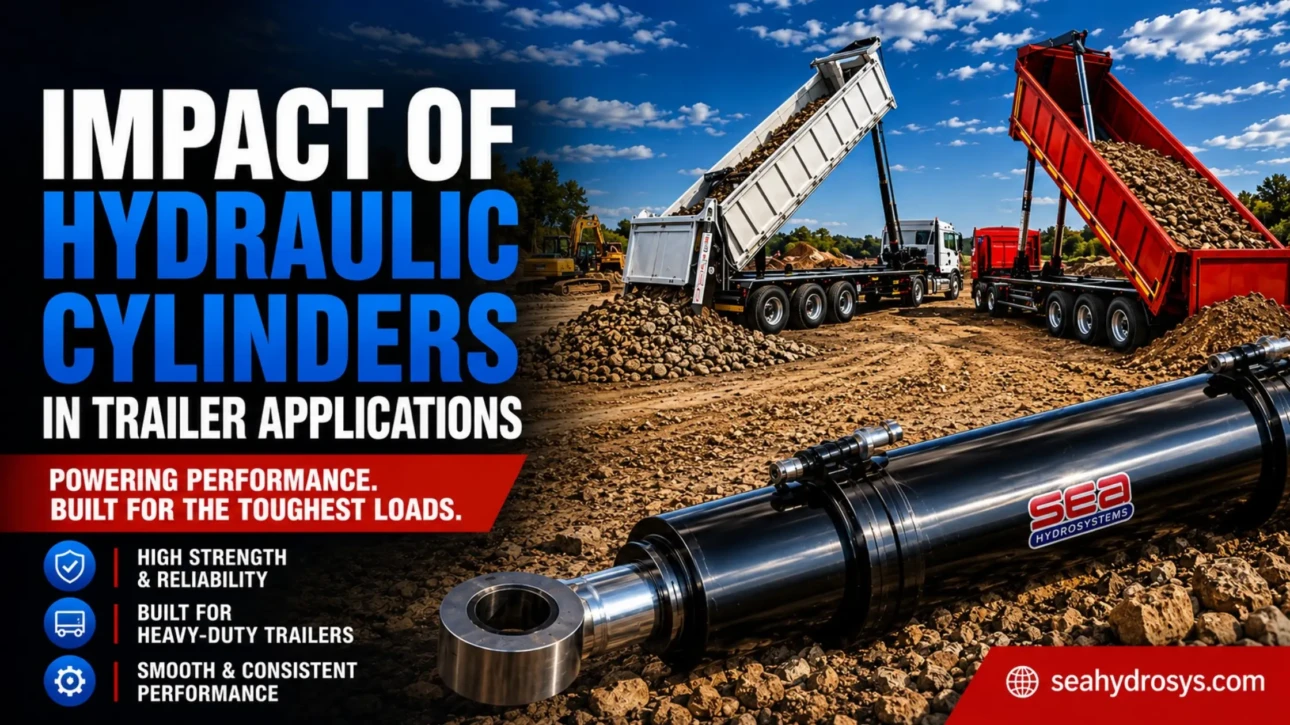
In trailer applications – especially tipping, dump, and transport trailers – the hydraulic cylinder serves as the primary force-generating component. Its function goes beyond simple lifting; it must handle dynamic loads, pressure fluctuations, and off-axis stresses while maintaining consistent performance over thousands of cycles.
Operational Realities in Trailer Hydraulics
Unlike stationary hydraulic systems, trailer-mounted hydraulic cylinders operate under highly variable and non-ideal conditions.
- Dynamic Load Shifts
During tipping, the load distribution continuously changes . As material flows, the center of gravity shifts, creating uneven force distribution. - Pressure Spikes (Transient Loads)
Sudden valve actuation or load drops can create short-duration pressure peaks exceeding nominal system pressure. - Side Loading (Misalignment Forces)
Improper mounting geometry or chassis flex introduces lateral forces on the piston rod, accelerating wear. - Environmental Contamination
Dust, moisture, and abrasive particles directly impact sealing systems and rod surface integrity.
These conditions must be factored into both design calculations and material selection.
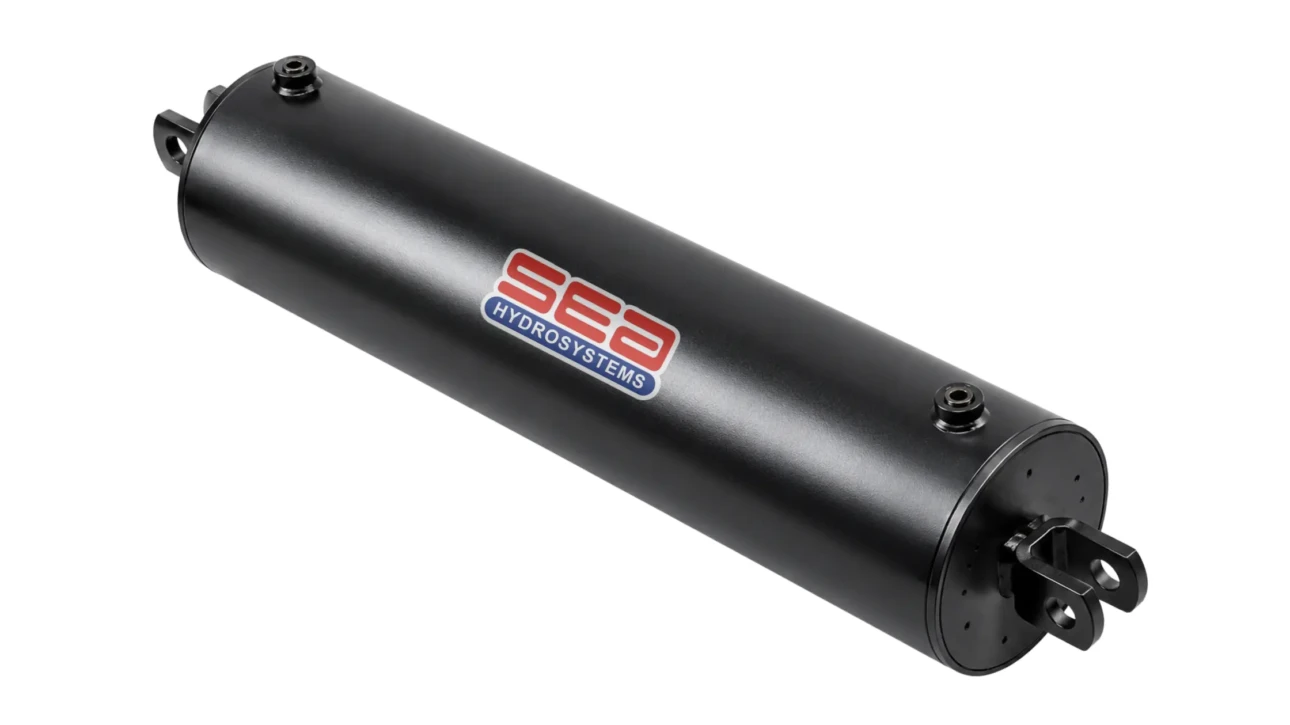
Cylinder Design Fundamentals for Trailer Applications
1. Bore Size and Force Output
The force generated by a hydraulic cylinder is governed by:
F=P×A
Where:
- F = Force (N)
- P = System pressure (Pa)
- A = Effective piston area (m²)
For trailer applications:
- Larger bore → higher force capacity
- But also → higher oil volume requirement and slower actuation (if pump flow is limited)
Correct bore sizing ensures adequate lifting force without overloading the hydraulic system.
2. Stroke Length and Application Fit
- Tipping trailers: Require long stroke, typically achieved using telescopic cylinders
- Utility or equipment trailers: Often use shorter stroke, double-acting cylinders
Stroke must be matched to:
- Required tipping angle
- Mounting geometry
- Space constraints in retracted condition
3. Telescopic Cylinder Mechanics
Telescopic cylinders are widely used in dump/tipping trailers due to their ability to achieve long extension from compact installation length.
Technical characteristics:
- Multi-stage sleeves extend sequentially
- First stage has the largest diameter → highest force
- Final stage has the smallest diameter → lowest force
This means:
- Maximum lifting force is available at the start of tipping (when load is highest)
- Force decreases as extension increases—this is intentional and matches load behavior.
4. Material and Surface Engineering
Critical components include:
- Cylinder Tube
- Honed to achieve surface roughness typically in the range of Ra 0.4–0.8 µm
- Ensures proper sealing and reduced wear
- Piston Rod
- Induction hardened for strength
- Hard chrome plated (typically 20–30 microns) for corrosion resistance and wear protection
- End Mounts (Clevis/Trunnion)
- Designed to accommodate angular movement
- Prevent stress concentration and misalignment
5. Sealing System Design
Trailer cylinders commonly use combinations of:
- PU (Polyurethane) seals → High wear resistance
- PTFE seals → Low friction, good for high-speed or temperature variation
- Wipers/Scrapers → Prevent ingress of contaminants
Seal failure is one of the most common causes of cylinder breakdown, typically due to:
- Contamination
- Excessive side load
- Poor surface finish
Single-Acting vs Double-Acting Cylinders
Single-Acting Cylinders
- Pressure applied in one direction (extension)
- Retraction via gravity or external load
- Common in tipping trailers
Double-Acting Cylinders
- Hydraulic power for both extension and retraction
- Used in applications requiring controlled movement
Failure Modes and Engineering Considerations
Common technical failures include:
- Rod Buckling
Occurs when compressive load exceeds critical load capacity (especially in long stroke cylinders) - Seal Extrusion
Due to high pressure or improper seal groove design - Scoring of Rod/Tube
Caused by contamination or inadequate lubrication - Mounting Misalignment
Leads to uneven wear and premature failure
To mitigate these:
- Proper mounting alignment is essential
- Use of spherical bearings or clevis mounts helps accommodate movement
- Regular maintenance and filtration improves longevity
At SEA Hydrosystems, we specialize in the design and manufacturing of application-specific hydraulic cylinders engineered for demanding industries such as trailers, construction, material handling, and mobile equipment.
Our approach is rooted in engineering precision and field performance:
- Cylinders are designed based on actual load calculations and duty cycles, not assumptions
- We use high-quality honed tubes and induction-hardened chrome-plated rods to ensure durability
- Sealing systems are selected based on pressure range, contamination exposure, and operating conditions
- Every product is developed with a focus on long service life, minimal maintenance, and consistent performance
For trailer applications, we engineer cylinders that address real-world challenges such as dynamic load shifts, pressure spikes, and misalignment stresses, ensuring reliable operation in both on-road and off-road environments.
Reach us : 📩 sales@seahydrosys.com