


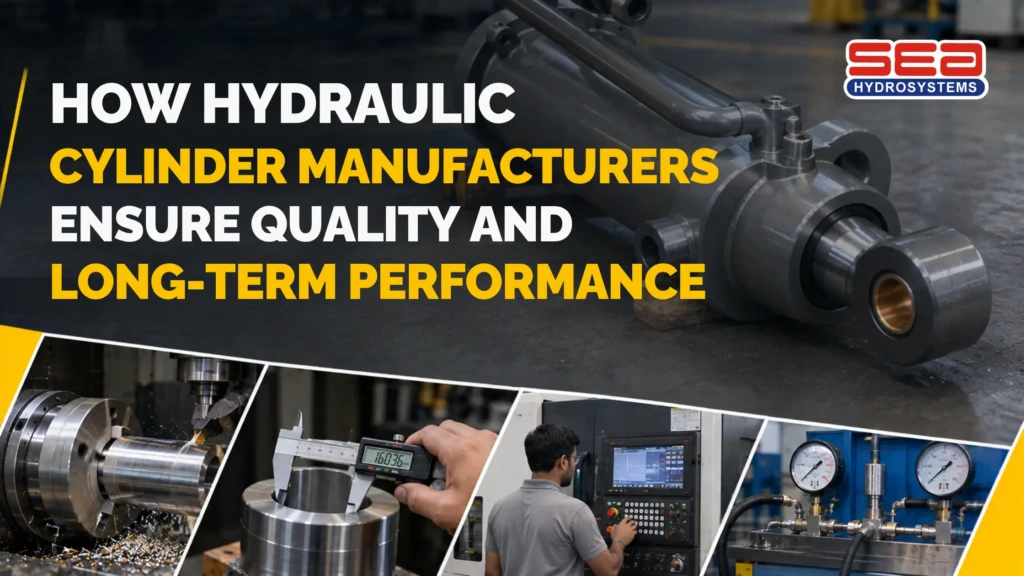
Hydraulic cylinders operate under pressure, repeated movement, changing loads, and often demanding environmental conditions. Their reliability depends on more than the quality of individual components. Material selection, machining accuracy, assembly practices, inspection, and testing all influence how consistently a cylinder performs throughout its service life.
For original equipment manufacturers (OEMs), an unreliable cylinder can result in equipment downtime, unexpected maintenance, production delays, and additional operating costs. This is why evaluating the manufacturing and inspection processes behind a cylinder is an important part of supplier selection.
At SEA Hydrosystems, we understand the importance of dependable hydraulic solutions. This article explains the manufacturing practices, inspection methods, and documentation buyers should consider when evaluating a supplier.
Why Quality Matters in Hydraulic Cylinder Manufacturing
A hydraulic cylinder contains several components that must work together under specified operating conditions. A dimensional error, unsuitable seal material, inadequate surface finish, or defective weld can affect performance and service life.
Effective quality management helps identify problems before products reach the customer. It also provides a consistent approach to checking materials, controlling production processes, and verifying finished components.
For OEMs and industrial equipment manufacturers, the benefits include:
- More consistent cylinder performance across production batches.
- Reduced risk of premature component failure.
- Better compatibility with equipment requirements.
- More predictable maintenance and replacement planning.
- Improved confidence in supplier quality and delivery consistency.
A manufacturer’s quality approach should therefore be evaluated throughout the production process, rather than only by inspecting the finished product.
Material Selection and Incoming Inspection
Material quality is one of the starting points for reliable cylinder production. The barrel, piston rod, end caps, mounting components, and seals must be suitable for the cylinder’s intended application.
Before production begins, manufacturers should verify that incoming materials meet the specifications defined in the engineering drawings and purchase requirements.
Important checks include:
- Material grade: Confirming that steel and other materials meet the specified mechanical and chemical requirements.
- Material documentation: Reviewing mill test certificates or other relevant supplier documents when required.
- Rod material and coating: Checking the specified surface condition, coating quality, and dimensional requirements.
- Seal compatibility: Selecting seal compounds appropriate for the hydraulic fluid, temperature range, pressure, and operating environment.
- Traceability: Maintaining identification records that connect materials to production batches.
Material selection should be based on actual operating conditions. A cylinder exposed to moisture, dust, temperature variations, or frequent cycling may require different material and sealing considerations from one used in a controlled industrial environment.
Precision Machining and Component Preparation
Machining accuracy has a direct influence on cylinder fit, sealing, alignment, and movement. Even small variations in critical dimensions can create assembly problems or affect performance.
A controlled machining process should address the following areas:
Bore Machining and Honing
The cylinder barrel’s internal bore must meet the specified diameter, straightness, and surface-finish requirements. Honing helps achieve the required internal surface characteristics for piston and seal operation.
An unsuitable bore finish may contribute to excessive seal wear, leakage, or inconsistent movement.
Piston Rod Machining and Surface Finish
The piston rod must meet the required dimensional and surface-finish specifications. Its surface condition is important because the rod passes through the sealing arrangement during operation.
Incorrect dimensions, surface damage, or unsuitable coating quality can increase wear and affect sealing performance.
Component Alignment and Tolerances
Critical components such as the piston, gland, rod, and barrel must fit according to the engineering drawing. Dimensional inspection helps identify variations before final assembly.
Welding and Joint Preparation
Welded components should be produced using documented procedures appropriate to the material, joint design, and application. Inspection should verify weld appearance, dimensions, and any additional acceptance requirements specified for the product.
These manufacturing controls help maintain consistency and reduce the likelihood of defects progressing to later production stages.
Hydraulic Cylinder Testing: Methods Used to Verify Performance
Testing is an important part of the manufacturing process because it helps verify whether a finished cylinder meets its defined requirements. A well-defined hydraulic cylinder testing programme should consider the design, operating pressure, application, customer specification, and applicable standards.
Proof Pressure Testing
Proof pressure testing checks whether the cylinder’s pressure-containing structure can withstand a specified test pressure under controlled conditions.
The test pressure, duration, procedure, and acceptance criteria must be established from the relevant design requirements and applicable specifications. A single test pressure should not be assumed suitable for every cylinder.
Test results should be recorded against the cylinder’s identification or production reference.
Leakage Testing
Leakage inspection checks for unwanted hydraulic fluid leakage from relevant sealing areas, ports, connections, and other specified locations.
The inspection procedure should define the operating or test conditions and the acceptance criteria. Internal leakage and external leakage should also be considered separately where relevant to the design.
Dimensional Inspection
Dimensional inspection verifies that important features match the approved engineering drawing.
Typical inspection points include:
- Bore diameter and barrel dimensions.
- Piston rod diameter and straightness.
- Overall closed and extended lengths.
- Stroke length.
- Mounting dimensions and connection locations.
- Port dimensions and thread specifications.
Measurement equipment should be appropriate for the required tolerance and maintained in a calibrated condition.
Functional and Cycle Testing
Functional testing verifies the cylinder’s movement and operation under specified conditions. Depending on the application, this may include checking extension, retraction, cushioning, and operating behaviour.
Hydraulic cylinder testing may also include cycle testing for selected designs or applications where repeated movement and durability need to be evaluated. The number of cycles, load conditions, operating pressure, and acceptance criteria should be defined before testing.
Surface and Visual Inspection
Visual inspection helps identify visible defects such as scratches, corrosion, damaged threads, coating defects, contamination, or assembly issues.
It should be performed at appropriate stages, including before final packaging and dispatch.
Hydraulic Cylinder Quality Control Throughout Production
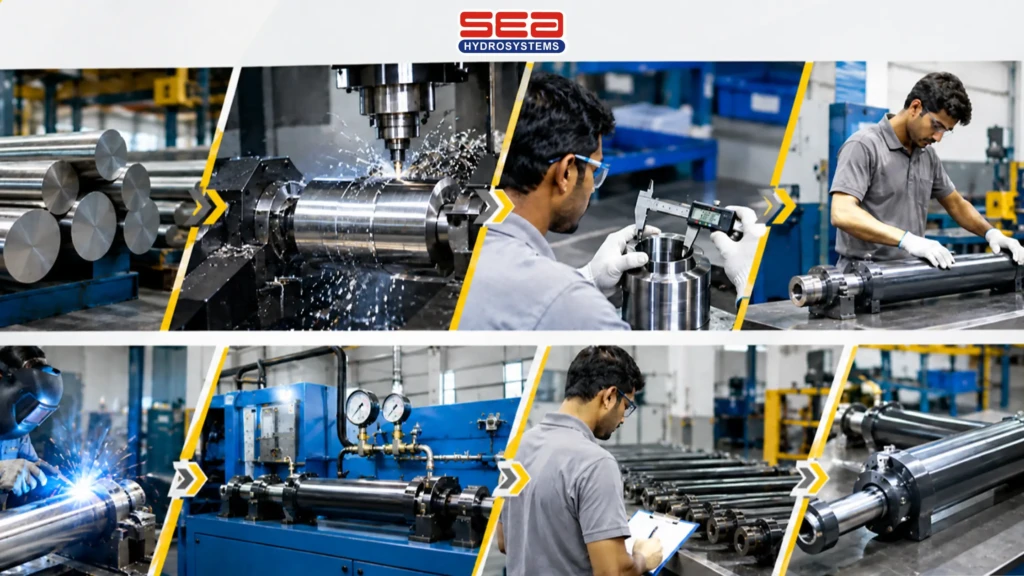
Quality checks should not be limited to the final inspection stage. A well-organised hydraulic cylinder quality control process includes verification at different manufacturing stages so that defects can be identified and corrected early.
A typical inspection sequence may include:
- Incoming inspection: Verify materials, component dimensions, and supporting documentation.
- In-process inspection: Check machining, honing, welding, and other critical production operations.
- Assembly inspection: Confirm component compatibility, cleanliness, fit, and assembly requirements.
- Final inspection: Verify dimensions, surface condition, identification, and specified functional requirements.
- Test verification: Review test results against the approved acceptance criteria.
- Dispatch inspection: Confirm packaging, protection, documentation, and order identification.
The inspection plan should identify what needs to be checked, how it will be measured, the acceptance criteria, and who is responsible for recording the results.
This systematic approach helps manufacturers identify deviations before they affect the finished product or the customer’s equipment.
Documentation and Product Traceability
Inspection and testing are more useful when the results are properly documented. Records help manufacturers investigate quality concerns, support customer audits, and identify the production history of a particular unit.
A strong hydraulic cylinder quality control system should include appropriate documentation based on the order and customer requirements, such as:
- Raw material certificates.
- Component inspection reports.
- Dimensional inspection records.
- Pressure or functional test reports.
- Production batch and serial number details.
- Non-conformance reports.
- Corrective action records.
- Final inspection and dispatch records.
Traceability connects a finished cylinder with relevant material, production, and inspection information.
If a problem is reported after delivery, these records can help identify whether the issue is related to material, machining, assembly, testing, or another part of the production process.
OEM buyers should confirm which documents are supplied with each order and how long the manufacturer retains its production records.
Industry Standards and Quality Certifications
Standards and certifications can help buyers understand a manufacturer’s quality management approach. However, it is important to distinguish between a management-system certification and the technical requirements applicable to an individual cylinder.
ISO 9001 Quality Management
ISO 9001 provides a framework for establishing, maintaining, monitoring, and improving a quality management system. It addresses areas such as process control, customer requirements, documented information, performance evaluation, and continual improvement.
Certification indicates that an organisation’s quality management system has been assessed against the relevant edition by a certification body. It does not automatically guarantee that every individual product is defect-free.
For an overview of the standard, refer to the official ISO quality management information.
Hydraulic and Fluid Power Standards
Certain applications may require specific dimensional, performance, or pressure-related requirements for fluid power components.
The National Fluid Power Association (NFPA) maintains technical standards covering different fluid power products and applications. Buyers can use its fluid power standards directory to identify potentially relevant documents.
The applicable standard should always be confirmed against the cylinder design, application, customer specification, and contractual requirements.
Common Quality Problems and Their Possible Causes
Understanding how manufacturing issues appear during operation can help buyers and maintenance teams investigate problems more effectively.
Premature Seal Wear or Leakage
Possible contributing factors include unsuitable seal material, contamination, incorrect installation, incompatible operating conditions, or an unsuitable surface finish.
Piston Rod Corrosion or Surface Damage
This may be associated with environmental exposure, damaged protective coatings, inadequate surface preparation, or unsuitable material selection.
Inconsistent Cylinder Movement
Possible causes include internal friction, misalignment, contamination, incorrect assembly, or issues elsewhere in the hydraulic system.
Dimensional Variation Between Production Batches
Differences in machining settings, tooling condition, measurement methods, or process control can contribute to variations between units.
Weld-Related Defects
Weld defects may result from unsuitable procedures, poor joint preparation, or inconsistent execution. Inspection requirements should be based on the design and applicable acceptance criteria.
It is important not to assume that every field failure originates in manufacturing. Hydraulic system conditions, installation, maintenance, operating loads, and environmental exposure can also influence cylinder performance.
Continuous Improvement and Employee Training
Manufacturing quality depends on both defined processes and the people responsible for carrying them out.
A consistent improvement programme may include:
- Reviewing inspection results and recurring defects.
- Investigating customer complaints and field failures.
- Recording non-conformances and corrective actions.
- Maintaining machining and inspection equipment.
- Training employees on approved procedures.
- Reviewing process performance and updating work instructions.
- Using customer feedback to identify improvement opportunities.
Employee training is particularly important in machining, welding, assembly, inspection, and testing activities. Regular skills development helps employees understand product requirements and follow documented procedures consistently.
Continuous improvement should be supported by measurable evidence, such as defect trends, rework rates, inspection results, and corrective action effectiveness.
How Quality Requirements Change with Production Volume
The appropriate inspection approach can differ between prototype orders, low-volume custom production, and larger repeat orders.
Prototype and Low-Volume Production
Prototype and low-volume orders may require detailed individual inspections because each unit can have unique design features or limited production history.
The inspection plan should focus on critical dimensions, material requirements, assembly details, and application-specific testing.
Repeat and High-Volume Production
Repeat production benefits from consistent process settings, defined inspection checkpoints, and monitoring of production variation.
Sampling inspection or statistical process control may be appropriate where the process, risk level, customer requirements, and applicable quality plan support their use. Critical characteristics may still require individual verification.
Manufacturers should explain how inspection frequency and acceptance criteria are determined rather than applying the same approach to every order.
How OEM Buyers Can Evaluate a Manufacturer’s Quality Processes
When comparing suppliers, buyers should look beyond general statements about quality. They should ask for practical information about inspection methods, testing capabilities, documentation, and corrective action procedures.
When assessing a supplier’s hydraulic cylinder quality control procedures, buyers can ask:
- How are incoming raw materials verified?
- Which machining and assembly processes are controlled internally?
- How are critical dimensions measured and recorded?
- What pressure and functional tests are available?
- How are testing equipment and measuring instruments calibrated?
- What inspection reports can be supplied with an order?
- How are non-conforming components identified and controlled?
- How are customer complaints investigated?
- How are engineering drawing revisions communicated and implemented?
- How is production traceability maintained?
Buyers should also confirm whether the supplier can meet the required production volume, delivery schedule, technical specifications, and documentation requirements.
The Importance of Quality in Total Cost of Ownership
The purchase price is only one part of the overall cost of a hydraulic cylinder. A low initial price may not provide good value if the component requires frequent maintenance or causes equipment downtime.
The total cost of ownership may include:
- Initial purchase and installation costs.
- Maintenance and replacement expenses.
- Labour required for inspection and repair.
- Equipment downtime and lost production.
- Inventory and spare-part requirements.
- Costs associated with investigating recurring failures.
A reliable quality process can help reduce avoidable defects and improve production consistency. Buyers should therefore compare suppliers using both purchase cost and the expected operating requirements of the cylinder.
Frequently Asked Questions
Does ISO 9001 certification guarantee a defect-free hydraulic cylinder?
No. ISO 9001 relates to an organisation’s quality management system. It provides a framework for managing and improving processes, but it does not guarantee that every individual product will be defect-free. Product inspection and testing are still necessary.
What should buyers check in a cylinder test report?
A hydraulic cylinder testing report should identify the cylinder or production reference, test procedure, relevant test conditions, acceptance criteria, recorded results, and inspection status. Additional information may be required depending on the customer specification.
How often should hydraulic cylinders be tested?
Hydraulic cylinder testing frequency depends on the product design, application, operating conditions, customer requirements, and applicable standards. Manufacturers should define appropriate tests and acceptance criteria for each product or order.
What causes premature seal failure?
Potential causes include incompatible seal materials, contamination, unsuitable surface finish, incorrect installation, temperature variations, pressure conditions, and misalignment. The actual cause should be established through inspection and investigation.
Should custom cylinders have additional inspection requirements?
They may require additional verification because of their specific dimensions, mounting arrangements, operating conditions, or design features. The inspection and test plan should reflect the approved drawings and customer requirements.
What is the difference between quality certification and product testing?
Quality certification generally assesses an organisations management system against a defined standard. Product testing evaluates whether a particular component meets specified technical and performance requirements. Both provide different types of information to buyers.
Why Quality Matters When Choosing a Manufacturing Partner
A dependable manufacturing partner should be able to explain how materials are verified, production processes are controlled, finished components are inspected, and customer requirements are documented.
For OEMs, these capabilities support more consistent equipment integration, predictable production planning, and better control over long-term operating costs.
At SEA Hydrosystems, we work with customers to understand their hydraulic requirements and identify suitable cylinder solutions. Explore our custom cylinder solutions or contact our team to discuss your application.
Contact: sales@seahydrosys.com
Choose a manufacturing partner that understands the importance of quality, consistency, and long-term performance.

