


Mining, construction, and agriculture depend on mobile and industrial equipment that must perform under demanding operating conditions. Machines in these sectors lift, push, position, excavate, compact, and transport heavy materials. Their hydraulic systems must deliver controlled force while withstanding vibration, contamination, changing loads, and repeated operating cycles.
A heavy duty hydraulic cylinder is selected around the actual requirements of the machine: force, pressure, stroke, speed, mounting geometry, duty cycle, and environment. It is not simply a standard cylinder made larger. The barrel, rod, seals, bearings, mounting points, and surface protection must work together as a complete design.
Heavy duty hydraulic cylinders support lifting, positioning, and material-handling functions across many machine types.
At SEA Hydrosystems, we manufacture hydraulic cylinders for industrial and mobile equipment applications. A heavy duty hydraulic cylinder must be matched to the equipment’s real load cases and installation constraints. This guide explains where these components are used across three major industries, what operating conditions influence selection, and what OEMs should review when specifying a cylinder.
Heavy-Duty Hydraulic Cylinder Applications in Mining
Mining equipment works in environments where abrasive particles, vibration, impact, and demanding production schedules can place substantial stress on hydraulic components. Heavy duty hydraulic cylinders in these machines must be specified for the actual load spectrum and site conditions. Mining hydraulic cylinders are used in equipment that excavates, moves, supports, drills, and processes material. Their specifications must reflect the machine’s load cases and the conditions at the point of use.
Excavation and Material Handling
Large excavators, loaders, and haulage support equipment use cylinders to operate booms, arms, buckets, steering systems, and other mechanisms. Mining hydraulic cylinders in these functions need to accommodate the equipment’s force, travel, and mounting geometry.
These functions may involve high forces, changing load directions, and repeated cycles.
Cylinder selection should consider the maximum expected load, linkage geometry, stroke, operating pressure, rod exposure, and the possibility of side loading. The mounting arrangement is especially important: a cylinder designed for axial loading may wear prematurely if the equipment structure introduces bending or misalignment.
Crushing and Processing Equipment
Crushers, screens, feeders, and material-handling systems may use hydraulic cylinders for adjustment, positioning, tensioning, access panels, or other machine functions. These locations can be exposed to vibration, dust, and intermittent shock loads.
The cylinder and hydraulic circuit should be designed for the intended function. Where a cylinder is used for adjustment or positioning, engineers should define how the load is held, how pressure is controlled, and what protection is required if a hose or connection fails.
Underground Mining Equipment
Underground loaders, drilling equipment, roof-support systems, and service machines often operate within restricted spaces. Compact dimensions, accessible connections, protection from debris, and maintainability can be as important as force and stroke.
Mining hydraulic cylinders used underground should be evaluated for their mounting envelope, service access, environmental exposure, and the consequences of a loss of hydraulic power. The complete machine design should include suitable load-holding and safety provisions where the application requires them.
Design Priorities for Mining Operations
Mining operators and OEMs should document the expected load spectrum rather than relying on a single nominal load. Specifications for mining hydraulic cylinders should also record contamination exposure, temperature range, and planned maintenance access.
Consider peak loads, impact events, cycle frequency, temperature, contamination, and the available maintenance windows.
A practical design review should include:
- Required force throughout the full movement.
- Stroke and retracted dimensions.
- Mounting-pin sizes and allowable articulation.
- Rod surface protection and wiper arrangement.
- Hydraulic fluid cleanliness and filtration.
- Access for inspection and replacement.
- Safe support of raised or suspended machine components during service.
Heavy-Duty Hydraulic Cylinder Applications in Construction
Construction machinery moves between sites and works through changing ground, weather, and project conditions. Heavy duty hydraulic cylinders operate boom, steering, stabilizing, lifting, and attachment functions on many construction machines. Excavators, backhoes, cranes, loaders, rollers, concrete equipment, and lifting platforms use cylinders for controlled movement and load handling.
Excavators and Backhoes
Boom, arm, bucket, blade, and attachment functions rely on hydraulic force. These cylinders experience repeated movement and may encounter shock loads when buckets contact rock, compacted soil, or buried obstacles. A heavy duty hydraulic cylinder for this service should be assessed for impact loading, rod protection, and the full operating geometry.
A suitable specification considers the machine’s linkage geometry, bucket capacity, digging forces, operating pressure, stroke, and rod exposure. Protective measures should be selected for the actual working environment rather than added without considering clearance, maintenance, and the manufacturer’s design.
Cranes and Lifting Equipment
Cranes and lifting platforms use hydraulic cylinders for boom elevation, telescoping functions, stabilizers, steering, and platform movement, depending on equipment type. These are safety-sensitive applications. The cylinder rating, mounting structure, hydraulic circuit, and load-control devices must be considered as one system.
Engineers should confirm the load cases at different boom positions, the effect of mechanical leverage, and the stability of the complete machine. A cylinder’s theoretical force alone does not establish the safe lifting capacity of the equipment.
Compaction and Road-Building Equipment
Rollers, compactors, graders, and other road-building machines may use cylinders for steering, articulation, blade positioning, vibration-system functions, and attachment movement. Repetitive cycles and exposure to dust, mud, water, and debris influence component selection.
For these applications, seal protection, rod finish, connection routing, and access for routine inspection can affect serviceability. The duty cycle should be defined in terms of operating hours and expected cycle frequency.
Concrete and Material-Handling Equipment
Concrete pumps, placing booms, material handlers, and lifting attachments use hydraulic cylinders to position or move equipment. Loads may vary during the operating cycle, and the equipment may work in wet or abrasive conditions.
Cylinder selection should account for the full movement envelope, structural deflection, hose routing, and the possibility of uneven loading. The machine manufacturer should also define the operating limits and inspection procedures.
Heavy-Duty Hydraulic Cylinder Applications in Agriculture
Agricultural equipment operates in fields, farms, and outdoor environments where dust, moisture, plant residue, chemicals, and seasonal storage can influence hydraulic component performance. Heavy duty hydraulic cylinders are used where implements and machines require controlled lifting, folding, or positioning. Tractors, loaders, harvesters, balers, sprayers, trailers, and implements use cylinders for lifting, folding, steering, positioning, and material handling.
Tractors, Loaders, and Implements
Tractors use hydraulic cylinders for three-point hitch functions, front-end loaders, steering, and attachments. Implements such as ploughs, cultivators, and seeders may use cylinders to raise, lower, fold, or adjust working components.
The correct cylinder depends on implement weight, linkage geometry, required movement, hydraulic supply, and the tractor’s rated capabilities. A heavy duty hydraulic cylinder should not be selected from bore size alone when the implement geometry or working load has changed.
OEMs should avoid selecting a cylinder based only on a previous installation if the load or geometry has changed.
Harvesting Equipment
Combines and other harvesting machines use cylinders for header positioning, reel adjustment, unloading mechanisms, access panels, and other functions. Harvest periods can be time-sensitive, so inspection and maintenance planning before the season can help identify issues before equipment is needed.
A cylinder exposed to crop residue and dust may require suitable wipers, rod protection, and a cleaning plan. The design should also account for vibration and repeated adjustments during operation.
Balers and Material Handling
Balers use hydraulic force to compress material and operate gates, pickup mechanisms, and other moving assemblies. The cylinder specification should reflect compression loads, cycle rate, stroke, and the equipment’s mechanical arrangement.
Plant material and dust can accumulate around exposed components. Regular cleaning and inspection of rod surfaces, seals, hoses, and mounting points can help detect developing problems.
Sprayers and Folding Implements
Sprayers and folding implements may use cylinders to position booms and fold equipment for transport. These systems need controlled movement and secure holding arrangements. Engineers should consider transport vibration, wind loading where relevant, hose flexibility, and the risk of interference during folding.
Agricultural duty cycles vary widely. Some machines operate intensively during a short season, while others work throughout the year. Inspection and service schedules should reflect actual usage, storage conditions, and manufacturer guidance.
Common Design Requirements Across the Three Industries
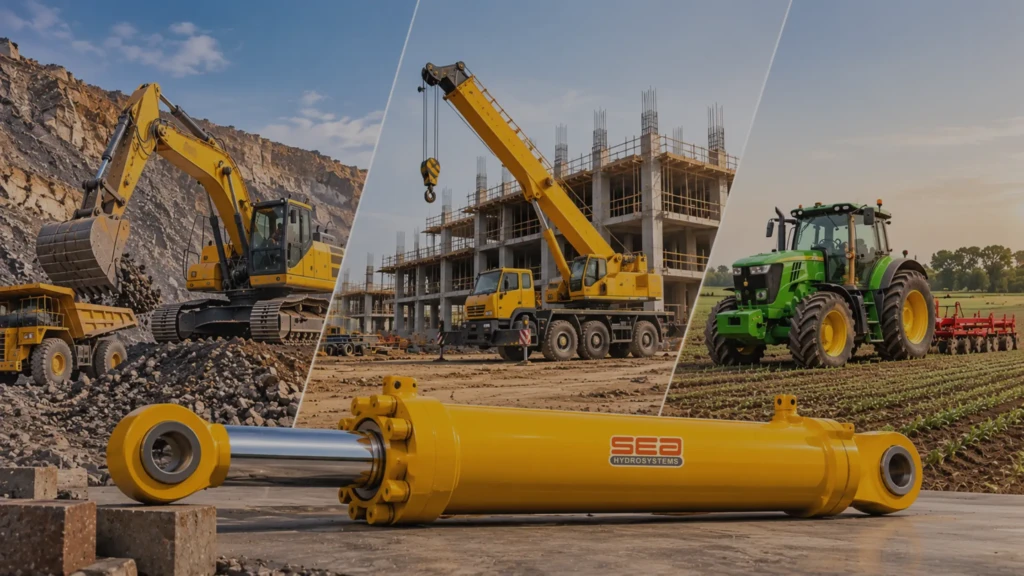
Although operating conditions differ, equipment manufacturers in mining, construction, and agriculture commonly evaluate several core design factors. Heavy duty hydraulic cylinders should be evaluated as part of the complete machine and hydraulic circuit.
Load and Force
The required cylinder force depends on hydraulic pressure and effective piston area. For the machine, however, the required force also depends on linkage geometry, load position, friction, acceleration, and external forces. Calculations should cover the full movement rather than a single convenient position.
Bore, Rod, and Stroke
Bore size influences available piston area, while rod diameter affects strength, buckling resistance, and the annular area in a double-acting arrangement. Stroke determines travel, but the retracted length and mounting dimensions determine whether the cylinder fits the equipment.
Mounting and Alignment
Pin locations, bearing arrangements, articulation, and structural stiffness influence cylinder life. Side loading can increase wear on the rod, guides, seals, and mounting components. The machine should be checked through its complete movement range to identify interference or alignment problems.
Pressure, Speed, and Duty Cycle
The hydraulic circuit must provide suitable pressure and flow for the required force and speed. Frequent cycling can increase heat generation and wear. Engineers should consider pressure peaks, cycle time, operating temperature, and the available cooling capacity of the hydraulic system.
Materials and Surface Protection
Material grades, heat treatment, rod finish, corrosion protection, and seal compounds should be selected for the application. No single material or coating is automatically best for every environment. The choice should reflect load, wear, corrosion exposure, temperature, fluid compatibility, and manufacturing requirements.
Environmental Factors That Influence Cylinder Selection
Mining: Abrasion and Particulate Exposure
Rock dust, ore particles, and debris can damage exposed rod surfaces and enter the sealing area. Wipers help remove contaminants as the rod retracts, but their effectiveness depends on the contamination type, rod finish, seal arrangement, and maintenance condition.
Mining hydraulic cylinders should be assessed for rod protection, wiper suitability, seal compatibility, and inspection access. NIOSH’s maintainability design checklist for underground equipment includes hydraulic-system maintenance considerations such as filter location, gauges, circuit identification, and safe system design. This is a useful reference when reviewing maintainability at the equipment level.
Construction: Weather and Job-Site Debris
Construction equipment may work in rain, mud, dust, temperature changes, and outdoor storage conditions. Cylinder selection should consider corrosion exposure, wiper design, rod protection, hose routing, and accessibility for cleaning and inspection.
Protective boots or guards can be useful in some applications, but they must not trap contaminants or interfere with the cylinder’s movement. Their suitability should be confirmed for the specific installation.
Agriculture: Chemical and Organic Exposure
Fertilizers, pesticides, cleaning agents, plant residue, and moisture can contact cylinder surfaces and seals. Chemical compatibility should be checked against the specific chemical, concentration, exposure duration, temperature, and seal compound. It is not accurate to assume that every agricultural chemical will damage every standard seal material.
Seasonal storage also matters. Before equipment is stored, exposed rods should be cleaned and inspected, damaged coatings should be assessed, and the machine should be stored according to its manufacturer’s instructions.
Maintenance Considerations by Industry
Maintenance intervals should be based on the equipment manufacturer’s recommendations, operating hours, duty cycle, environmental severity, inspection findings, and risk. A calendar-only schedule may not reflect the actual service conditions.
- Mining: Coordinate inspections with planned maintenance windows where practical. Pay attention to contamination, rod damage, loose mountings, leaks, and hydraulic filtration.
- Construction: Make routine visual checks practical for field crews. Inspect exposed rods, pins, hoses, connections, and signs of impact or misalignment.
- Agriculture: Schedule pre-season inspections and post-season cleaning. During storage, protect exposed components and follow the equipment manufacturer’s preservation guidance.
Maintenance teams should record leakage, unusual movement, temperature changes, visible damage, and repeated component failures. Trends across machines can help identify whether the issue relates to cylinder specification, hydraulic fluid cleanliness, installation, or operating practice.
Extending Cylinder Life in Abrasive Operating Conditions
Abrasive environments require attention to contamination control throughout the hydraulic system and at the cylinder’s exposed surfaces.
Useful practices include:
- Selecting wipers and seals for the actual contamination and temperature range.
- Protecting exposed rod sections where the equipment design allows.
- Maintaining hydraulic fluid cleanliness and replacing filters according to the service plan.
- Inspecting rods for scoring, corrosion, dents, and coating damage.
- Checking mounting pins, bushings, and alignment for wear.
- Repairing leaks and contamination sources promptly.
- Keeping service records to identify recurring problems.
A double-wiper arrangement may be appropriate in some highly contaminated applications, but it is not a universal solution. The correct arrangement depends on the cylinder design, contaminant type, rod condition, and operating environment.
Comparing Duty Cycles Across Industries
Duty cycle describes how often and how intensely a cylinder operates. It affects heat generation, wear, service planning, and component life.
Mining: High Utilization and Planned Shutdowns
Some mining equipment operates across multiple shifts, while other machines have different utilization patterns. Where usage is high, inspection planning should consider operating hours, load cycles, contamination, and the availability of planned shutdowns.
Construction: Project-Based Operation
Construction duty cycles can vary with project stages, machine type, and site conditions. A machine may experience intense use on one project and lower utilization during transport or downtime. Service planning should account for both operating and idle periods.
Agriculture: Seasonal Work Patterns
Agricultural equipment may be used intensively during planting or harvest and remain idle during other periods. Pre-season inspection, proper cleaning, and storage practices help prepare equipment for the next operating period.
There is no single inspection interval that applies to every machine in an industry. The equipment manufacturer and maintenance team should set intervals based on the actual risk and operating data.
The Cost of Downtime by Industry
Unplanned equipment downtime can affect production, project schedules, and seasonal work. The financial impact differs by operation.
- Mining: A machine failure may interrupt a material-handling process or reduce production capacity. The impact depends on equipment redundancy and the role of the affected machine.
- Construction: Equipment downtime can delay site activities, affect crew scheduling, and create additional rental or project costs.
- Agriculture: A failure during a narrow planting or harvesting window can disrupt time-sensitive work and require rescheduling.
When comparing cylinder options, consider more than the initial purchase price. Review expected service life, maintenance access, replacement lead time, spare-parts availability, and the consequences of equipment downtime. A higher-priced component is not automatically more economical; the decision should be based on documented requirements and lifecycle considerations.
Selecting a Cylinder Supplier with Cross-Industry Experience
A supplier should understand the application and be able to review the technical information needed to produce a suitable design. Experience across different sectors can be useful, but the cylinder must still be engineered for the specific machine and operating conditions.
When evaluating a supplier, OEMs should consider:
- Experience with the relevant equipment type and application.
- Ability to review load, pressure, stroke, and mounting requirements.
- Material and seal selection support.
- Manufacturing and inspection capabilities.
- Documentation, traceability, and change-control practices.
- Production capacity, lead times, and communication.
- Technical support during prototype evaluation and production.
Provide a clear technical specification when requesting a quotation. Include drawings, mounting dimensions, bore and rod requirements, stroke, operating pressure, hydraulic fluid, duty cycle, environmental conditions, and expected annual quantities. If any information is not yet available, identify it as an assumption rather than treating it as a confirmed requirement.
Evaluating Fleet-Wide Cylinder Standardization
Operations with mixed fleets may benefit from standardizing selected components where the engineering requirements allow it. Standardization can simplify spare-parts inventory, purchasing, and maintenance training.
However, cylinders should not be made interchangeable solely to reduce part numbers. Different machines may have different loads, mounting geometry, strokes, operating pressures, and duty cycles. A common specification is appropriate only when those requirements are compatible and the equipment manufacturer approves the arrangement.
Preparing for Seasonal and Cyclical Demand
Construction and agricultural operations may experience seasonal demand changes. Planning inspections, replacement parts, and maintenance work during lower-utilization periods can reduce the chance of avoidable interruptions during busy periods.
For multi-site operations, purchasing teams can coordinate forecasts with equipment dealers, service teams, and manufacturers. Forecasts should distinguish planned replacement demand from unexpected failures and new equipment production requirements.
Working with Equipment Dealers and OEMs on Cylinder Sourcing
Cylinder sourcing may involve the equipment owner, a dealer, a service provider, and the original equipment manufacturer. Before selecting a replacement, confirm whether the existing cylinder specification is still suitable for the machine’s current configuration.
A replacement should not be chosen on outside dimensions alone. Confirm bore, rod, stroke, closed length, mounting style, port details, pressure rating, cushioning, and the required performance. Any proposed change to the specification should be reviewed for its effect on machine structure and hydraulic-system performance.
Safety Considerations for Heavy-Duty Applications
Hydraulic systems can retain stored energy even after a machine has been switched off. Raised loads and moving machine members can also create serious hazards during service. Equipment should be supported and isolated using the procedures specified by the machine manufacturer and the applicable workplace safety requirements.
Before maintenance, trained personnel should identify energy sources, isolate the equipment, relieve or restrain stored energy, and verify that it is safe to begin work. OSHA’s control of hazardous energy requirements describe lockout/tagout requirements for covered servicing and maintenance activities, including control of stored energy. Applicability depends on the workplace and jurisdiction; employers should follow the regulations that apply to their operation.
Important safety practices include:
- Never work beneath a raised load supported only by hydraulic pressure.
- Use approved mechanical supports and isolation procedures.
- Do not exceed the equipment’s rated load or operating limits.
- Do not loosen hydraulic connections until pressure has been safely relieved.
- Inspect hoses, fittings, mountings, and cylinders for visible damage.
- Train operators to report leakage, unusual movement, or changes in equipment behaviour.
Looking Ahead: Evolving Demands on Heavy-Duty Cylinders
Mining, construction, and agricultural equipment continues to evolve through higher productivity requirements, automation, electronic controls, and more detailed maintenance data. These developments can influence cylinder design, mounting arrangements, sensors, and integration with the wider hydraulic system.
OEMs should assess new requirements through engineering validation rather than assuming that a design suitable for an earlier machine will automatically suit a revised model. Prototype testing, application trials, and documented design reviews help confirm that the selected cylinder meets the intended operating conditions.
Regional and Climate Considerations
Equipment operating in different climates may require different material, seal, and protection choices. Low temperatures can affect fluid viscosity and seal flexibility. High temperatures can influence fluid condition and elastomer performance. Humidity, coastal exposure, and corrosive substances can increase the need for suitable surface protection.
Specify the expected temperature range, fluid type, exposure conditions, and storage environment when requesting a cylinder. These details help the manufacturer assess materials and sealing arrangements more accurately.
Frequently Asked Questions
Are the same cylinders suitable for mining, construction, and agriculture?
Some basic design principles are common, but the required bore, rod, stroke, mounting, seals, coatings, and protection can differ significantly. Each application should be evaluated using its actual load and operating conditions.
What information should an OEM provide when requesting a cylinder?
Provide the application, load, operating pressure, bore and rod requirements if known, stroke, retracted length, mounting details, hydraulic fluid, duty cycle, environmental conditions, and expected quantity. Drawings and photographs of the installation can help clarify space and connection requirements.
How often should a cylinder be inspected?
There is no universal interval for every application. Follow the equipment manufacturer’s instructions and adjust inspection planning based on operating hours, duty cycle, contamination, risk, and previous inspection findings.
Can an existing machine be retrofitted with a different cylinder?
A retrofit may be possible, but the replacement must be checked for dimensions, mounting, force, stroke, pressure, hydraulic connections, and structural compatibility. Changes should be reviewed by a qualified equipment or hydraulic-system engineer.
Do agricultural chemicals always damage hydraulic seals?
No. Compatibility depends on the chemical formulation, concentration, temperature, exposure duration, and seal material. Confirm compatibility using the seal supplier’s technical information and the actual chemicals used.
Are double wipers always better for mining and construction equipment?
Not necessarily. A double-wiper arrangement may help in certain contamination conditions, but the choice depends on the cylinder design, contaminant type, rod finish, and maintenance requirements.
Is a higher-priced cylinder always the better choice?
No. Compare the design against the required performance, service life, maintenance needs, lead time, and downtime consequences. The most suitable option is the one that meets the application requirements with an appropriate lifecycle cost.
Need Hydraulic Cylinders for Demanding Equipment?
Choosing a cylinder for mining, construction, or agricultural machinery requires a clear understanding of load, pressure, stroke, mounting geometry, duty cycle, and environmental exposure. SEA Hydrosystems works with customers to understand their application requirements and manufacture hydraulic cylinder solutions for industrial and mobile equipment.
Explore our custom hydraulic cylinder solutions and share your equipment drawings or technical specifications with our team.
Contact: sales@seahydrosys.com

