


Different industries place very different demands on their equipment. A construction machine may operate under heavy loads and harsh outdoor conditions, while agricultural equipment may work through long operating cycles in dusty and wet environments. Marine equipment, meanwhile, may face corrosion, moisture, and demanding operating conditions.
These requirements can make application-specific engineering important. Custom cylinders allow equipment manufacturers and OEMs to develop hydraulic actuation solutions around the actual machine rather than forcing the equipment to accommodate a generic component.
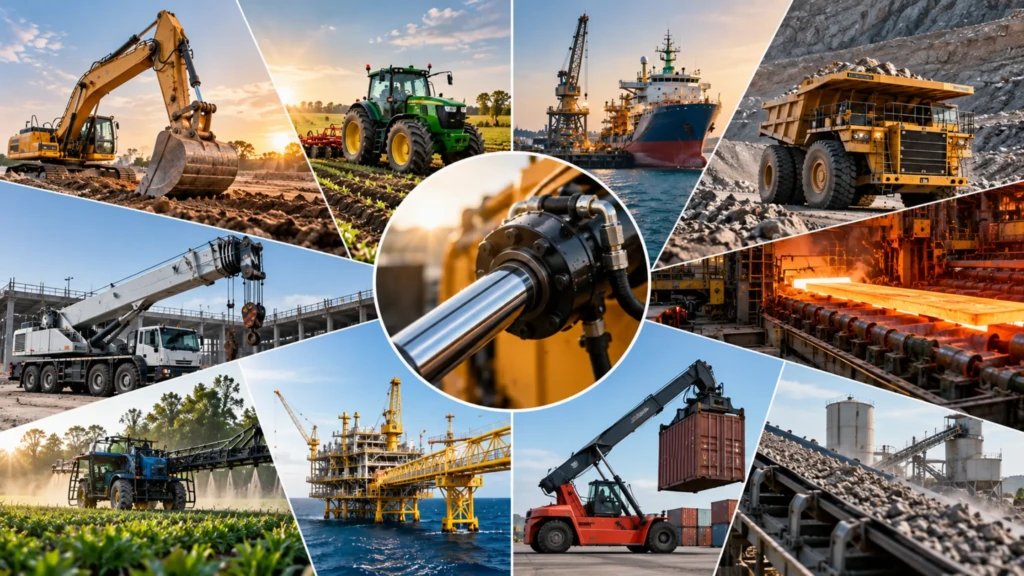
From construction and agriculture to marine, mining, material handling, steel processing, and specialized OEM machinery, custom hydraulic cylinders can be designed around specific operating conditions, space limitations, mounting requirements, and performance expectations.
This article explains the industries where customized cylinder solutions can provide particular value and the application requirements that make customization important.
Why Different Industries Need Different Cylinder Designs
A cylinder used in one industry may not be suitable for another application, even when both machines require linear movement.
Operating requirements can vary based on:
- Load and force requirements
- Available installation space
- Stroke length
- Operating pressure
- Cycle frequency
- Temperature
- Moisture and corrosion exposure
- Mounting arrangement
- Rod protection requirements
- Required service life
- Equipment size and weight
For example, agricultural equipment may need protection from dirt and moisture, while marine equipment may require additional attention to corrosion resistance. Steel-processing machinery may operate under high loads and temperatures.
This is where custom cylinders can become useful. Instead of relying only on standard configurations, manufacturers can develop cylinder specifications around the actual application.
1. Construction and Heavy Equipment
Construction equipment operates under demanding mechanical and environmental conditions. Excavators, loaders, cranes, drilling equipment, dump trucks, and other machines depend on hydraulic actuation for lifting, positioning, digging, and attachment control.
Space limitations are also common in construction equipment. A cylinder may need to fit between structural members, inside an attachment, or within a specific boom or linkage arrangement.
Custom hydraulic cylinders can be developed with application-specific:
- Bore and rod dimensions
- Stroke lengths
- Mounting configurations
- Port locations
- Rod materials and coatings
- Cushioning requirements
- Seal arrangements
The objective is not simply to produce more force. The cylinder must work correctly with the machine’s geometry, movement, load, and operating environment.
This makes customized solutions particularly relevant for OEM construction equipment manufacturers developing machines with unique layouts.
2. Agriculture and Farming Equipment
Agricultural machinery operates in environments where dust, soil, moisture, vibration, and frequent cycling are common.
Hydraulic actuation is used in equipment such as:
- Tractors
- Harvesters
- Sprayers
- Balers
- Tillage equipment
- Planters
- Agricultural loaders
- Specialized implements
The cylinder may control lifting, folding, steering, positioning, or adjustment functions.
Agricultural machinery can also have strict space and weight requirements. A cylinder that is too large can interfere with machine components, while an unsuitable mounting arrangement can complicate installation.
For these applications, custom cylinders can be configured around the machine’s available space and movement requirements.
A purpose-built design can also consider operating cycles, exposure to outdoor conditions, and the specific attachment or implement being controlled.
3. Marine and Offshore Equipment
Marine and offshore applications can place particularly demanding requirements on hydraulic components.
Equipment may be exposed to:
- Saltwater
- High humidity
- Corrosive environments
- Changing temperatures
- Continuous operating cycles
- Difficult maintenance conditions
Hydraulic actuation can be used for marine handling systems, offshore equipment, lifting mechanisms, vessel equipment, and specialized subsea applications.
In these environments, cylinder construction, surface protection, sealing, material selection, and serviceability can become important design considerations.
For example, specialized offshore equipment may require cylinders designed specifically for lifting and positioning functions. A documented offshore lifting application demonstrates how purpose-built high-tonnage cylinders can be engineered for heavy lifting and corrosion-resistant operation. Read about marine lifting applications.
For this reason, custom hydraulic cylinders can be valuable when environmental exposure and equipment geometry make a standard configuration unsuitable.
4. Material Handling and Lifting Equipment
Material handling equipment often requires controlled movement, reliable positioning, and repeatable operation.
Applications include:
- Forklifts
- Lifting platforms
- Industrial handling equipment
- Work trucks
- Loaders
- Specialized lifting machines
- Warehouse equipment
The cylinder may have to operate within a confined mechanical arrangement while handling repetitive loads.
In these applications, the mounting configuration and overall dimensions can be just as important as force output. The cylinder must integrate properly with the machine’s linkage or lifting mechanism.
Custom cylinders can therefore be developed with application-specific mounting points, stroke requirements, port locations, and dimensional constraints.
This can help OEMs integrate the cylinder into the machine during the design stage instead of modifying the machine around an unsuitable component.
5. Steel and Metal Processing
Steel mills and metal-processing equipment can expose hydraulic components to demanding operating conditions.
Applications may involve:
- High mechanical loads
- High operating temperatures
- Heavy production cycles
- Dust and contamination
- Limited installation space
- Continuous industrial operation
Hydraulic cylinders can be used for positioning, clamping, lifting, pressing, and other controlled movements.
A cylinder used in these environments may require specialized materials, sealing arrangements, protective features, or dimensional configurations.
Custom hydraulic cylinders can be engineered around the equipment’s operating conditions rather than relying solely on standard dimensions.
This is particularly useful when the application involves unusual stroke lengths, large force requirements, specialized mounting, or environmental challenges.
6. Mining and Heavy-Duty Equipment
Mining equipment is exposed to some of the most demanding operating environments in industry.
Machines can experience:
- Heavy loads
- Abrasive dust
- High vibration
- Shock loading
- Long operating cycles
- Difficult maintenance conditions
Hydraulic cylinders may be used in mining machinery, crushing equipment, material handling systems, drilling equipment, and other heavy-duty applications.
The cylinder design may need to account for mechanical loading, environmental contamination, available installation space, and required service life.
In these applications, custom cylinders can be developed to match the machine’s specific mechanical requirements.
Rather than treating the cylinder as an isolated component, the design can consider how it interacts with the complete machine.
7. Cement and Industrial Processing Equipment
Cement plants and other heavy industrial processing facilities operate continuously and often expose equipment to dust, vibration, and high mechanical loads.
Hydraulic cylinders may be used for:
- Material handling
- Positioning
- Clamping
- Gate operation
- Lifting mechanisms
- Equipment adjustment
A cylinder used in this environment may need additional protection against contamination and wear.
Application-specific cylinder dimensions and mounting configurations can also help engineers integrate hydraulic actuation into machinery where installation space is restricted.
This is one reason industrial OEMs may work with custom hydraulic cylinder manufacturers when standard configurations cannot meet the complete application requirements.
8. Specialized Mobile Equipment
Specialized mobile equipment includes machines designed for particular applications rather than general-purpose operation.
Examples include:
- Utility vehicles
- Forestry equipment
- Road maintenance machines
- Specialized work trucks
- Mobile lifting systems
- Waste-handling equipment
These machines often have unique frame layouts and limited installation space.
Weight is another important consideration. Additional component weight can affect the overall machine design, especially for mobile equipment.
Customized cylinder configurations can help OEMs address space, weight, mounting, and movement requirements during the machine-development process.
Recent industry research also highlights automation, sensor integration, precision, and electrification as important trends affecting fluid-power designs for construction equipment, agricultural machinery, forklifts, and other mobile applications. Explore mobile fluid-power design trends.
9. High-Temperature and Specialized Industrial Applications
Some industrial machines operate in environments where temperature and material compatibility require special attention.
Examples include:
- Foundry equipment
- Metal-processing machinery
- Industrial presses
- Furnace-related equipment
- Specialized manufacturing machinery
In these applications, the cylinder design may need to consider:
- Temperature exposure
- Seal compatibility
- Rod protection
- Material selection
- Mounting conditions
- Operating frequency
A standard configuration may not provide the required combination of dimensions and environmental protection.
Working with custom hydraulic cylinder manufacturers can allow equipment designers to define the cylinder around the actual operating conditions.
10. Specialized OEM Machinery
OEM machinery is one of the important areas for application-specific cylinder development.
OEMs often design machines around their own:
- Mechanical layouts
- Performance requirements
- Production processes
- Space constraints
- Control systems
- Service requirements
A cylinder is therefore not simply a purchased component. It becomes part of the machine’s overall engineering design.
Custom cylinders can be developed around the OEM’s drawings and application requirements, helping ensure that dimensions, mounting points, stroke, ports, and other characteristics match the machine.
This approach can be particularly useful for equipment manufacturers producing specialized machinery in low or medium volumes.
What Can Be Customized?
Customization does not necessarily mean designing every component from the beginning. Depending on the application, specific cylinder characteristics can be modified to suit the equipment.
Bore and Rod Dimensions
Bore and rod dimensions can be selected according to required force, load conditions, available space, and mechanical requirements.
Stroke Length
The stroke can be specified to match the required movement of the machine.
Mounting Configuration
Different mounting arrangements can help the cylinder integrate with the equipment’s mechanical structure.
Port Location
Port positioning can be adjusted to improve hose routing and installation within confined spaces.
Materials and Surface Protection
Materials, coatings, and surface treatments can be considered according to the operating environment.
Sealing Arrangement
Seal selection can take into account pressure, temperature, speed, fluid compatibility, and environmental exposure.
Cushioning and Additional Features
Depending on the application, cushioning and other application-specific features can be incorporated into the design.
Signs Your Industry May Benefit from Custom Cylinders
Customization may be worth considering when:
- A standard cylinder does not fit the available space.
- The required stroke is not available in standard configurations.
- Existing mounting points do not match available products.
- Port locations create installation difficulties.
- The application operates in an aggressive environment.
- The equipment requires unusual dimensions.
- The machine has strict weight limitations.
- The cylinder experiences unusually high cycle rates.
- Existing cylinders require frequent modification or adaptation.
- The OEM needs a consistent design across a specialized equipment range.
The important point is that customization should be driven by an actual application requirement rather than added simply for the sake of customization.
Working With a Custom Cylinder Manufacturer
For an OEM or equipment manufacturer, early engineering communication can make the development process more effective.
Before manufacturing begins, the application should clearly define:
- Required force
- Stroke
- Operating pressure
- Cycle frequency
- Mounting points
- Available installation space
- Operating temperature
- Environmental exposure
- Hydraulic fluid
- Expected service conditions
Drawings, dimensions, operating information, and machine requirements can then be used to develop an appropriate cylinder configuration.
Experienced custom hydraulic cylinder manufacturers can work with OEM engineering teams to translate these requirements into a practical cylinder design.
This application-focused approach is particularly useful when the cylinder is a critical part of the machine’s overall movement system.
How Industry-Specific Customization Adds Value
The main advantage of customization is application compatibility.
A cylinder designed around the equipment can potentially help with:
- Better mechanical integration
- More efficient use of available space
- Simplified installation
- Improved hose routing
- Appropriate environmental protection
- Consistent OEM machine design
- Reduced need for modifications during assembly
However, the right solution depends on the individual application. Not every machine requires a fully customized design.
The decision should be based on the equipment’s actual requirements, operating environment, production volume, and engineering objectives.
Custom Cylinder Solutions from SEA Hydrosystems
SEA Hydrosystems provides application-focused cylinder solutions for industrial and OEM requirements. The company works with different industries, including agriculture, construction, marine and offshore, material handling, and industrial manufacturing.
Its capabilities include developing cylinder configurations around specific application requirements such as dimensions, stroke, mounting, and operating conditions.
Explore the SEA Hydrosystems product range to understand the available cylinder solutions.
For projects requiring application-specific engineering, SEA Hydrosystems also provides custom cylinder solutions for OEM and industrial applications.
Conclusion
Different industries place different demands on hydraulic actuation. Construction machinery requires solutions that can handle heavy loads and challenging environments, while agriculture requires dependable operation in outdoor conditions. Marine, mining, material handling, steel processing, and specialized OEM machinery each bring their own engineering requirements.
Custom cylinders can provide a practical solution when standard configurations do not adequately match the machine’s dimensions, operating environment, mounting arrangement, or performance requirements.
By working with experienced custom hydraulic cylinder manufacturers, OEMs and industrial equipment manufacturers can develop cylinder configurations around the actual requirements of their equipment.
The right approach is to begin with the application, understand its operating conditions, and then determine whether a customized cylinder configuration provides a meaningful engineering advantage.
Need a cylinder designed for your specific application? Contact SEA Hydrosystems to discuss your OEM or industrial requirements.

